
Introduction
In drilling operations, some of the most expensive and time-consuming problems do not originate from equipment failure or pressure control issues. Instead, they begin deep inside the formation itself—particularly in reactive shale sections.
Shale instability remains one of the biggest challenges in modern drilling engineering. It can lead to wellbore collapse, stuck pipe incidents, excessive torque and drag, poor hole cleaning, and significant non-productive time (NPT). These problems not only increase operational costs but can also compromise overall well integrity.
As drilling activities move toward deeper, more complex, and highly reactive formations, controlling shale hydration has become increasingly important. Over the years, the industry has introduced multiple shale inhibition technologies, including polymers, amines, silicates, and advanced synthetic inhibitors. Yet despite all these innovations, one chemical continues to remain the industry benchmark:
Potassium Chloride (KCl).
For decades, potassium chloride has been considered the gold standard for shale inhibition in water-based drilling fluids because of its reliability, chemical effectiveness, operational simplicity, and cost-performance balance.
Understanding why KCl has maintained this position requires a deeper look into shale behavior, clay hydration mechanisms, and the chemistry of inhibition itself.
What Makes Shale a Drilling Challenge?
Shale formations are composed largely of fine-grained sedimentary rocks containing clay minerals such as:
• Smectite
• Illite
• Montmorillonite
• Mixed-layer clays
These clay minerals are highly sensitive to water.
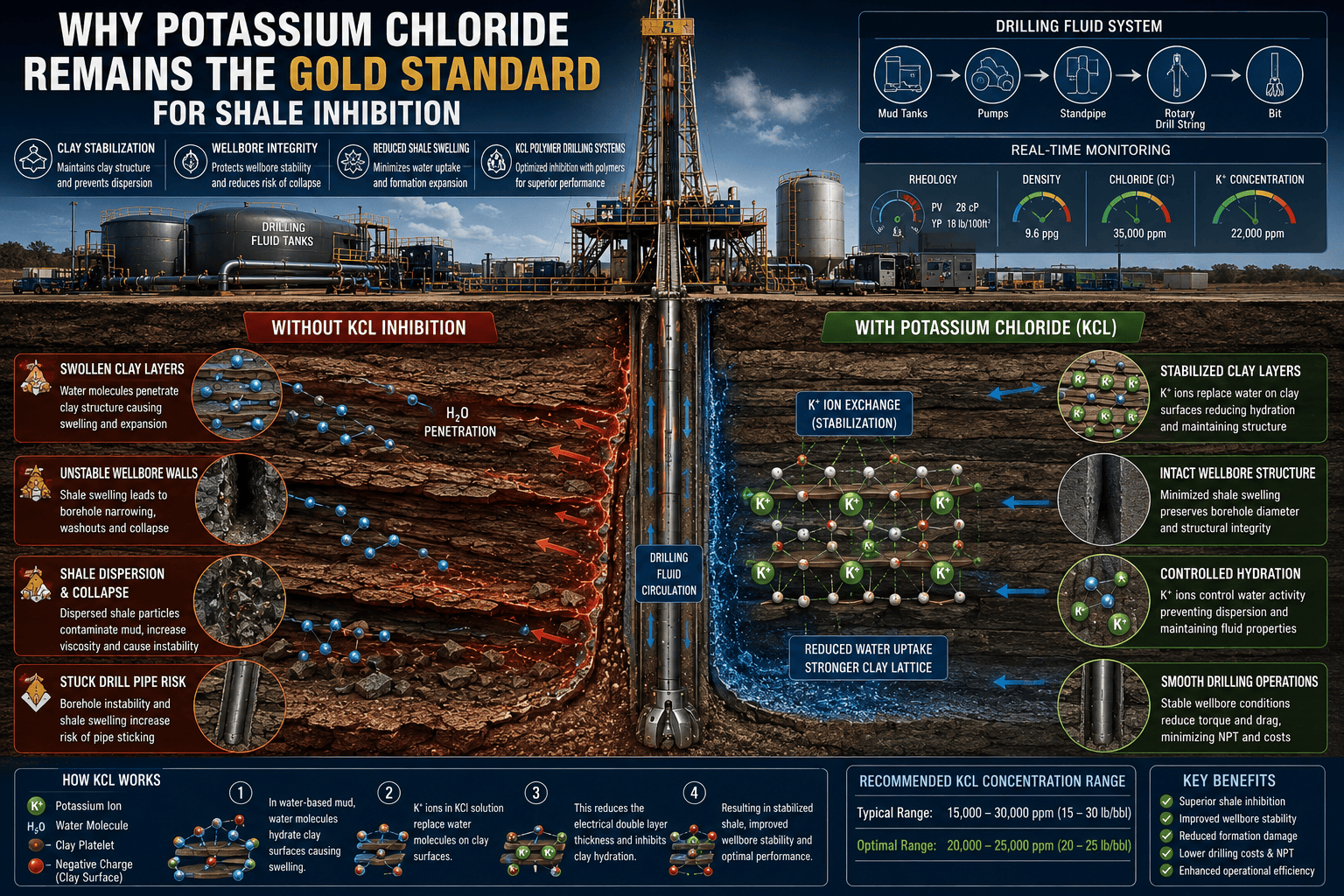
When water-based drilling fluids interact with reactive shale, water molecules penetrate between clay layers, causing swelling and dispersion. This changes the mechanical properties of the formation and weakens wellbore stability.
The severity of the problem depends on:
• Clay mineral composition
• Formation pressure and temperature
• Exposure time
• Drilling fluid chemistry
In highly reactive formations, uncontrolled hydration can rapidly destabilize the wellbore.
The Mechanism of Shale Swelling
Shale swelling primarily occurs through two mechanisms:
Crystalline Swelling
This occurs when water molecules enter the interlayer spaces of clay minerals, causing the clay structure to expand.
Osmotic Swelling
In osmotic swelling, differences in ion concentration between the drilling fluid and shale formation drive water deeper into the clay structure, resulting in further expansion and dispersion.
Both mechanisms weaken the shale and increase the risk of operational problems.
Consequences of Poor Shale Inhibition
When shale hydration is not properly controlled, drilling operations can experience:
• Wellbore enlargement and collapse
• Tight hole conditions
• Stuck drill pipe
• Increased torque and drag
• Poor cementing quality
• Excessive mud contamination
These issues directly impact drilling efficiency and operational costs.
In severe cases, instability may require sidetracking or complete well redesign.
Evolution of Shale Inhibition Technologies
To combat shale instability, the industry has developed multiple inhibition systems over the years.
These include:
• Salt-based inhibition systems
• Polymer encapsulation systems
• Glycol and amine inhibitors
• Silicate-based drilling fluids
• Synthetic and nano-engineered inhibitors
Despite these advancements, potassium chloride continues to remain one of the most widely used shale inhibitors globally.
The reason lies in its unique interaction with clay minerals.
Why Potassium Chloride Works So Effectively
Potassium chloride provides shale inhibition primarily through ion exchange and electrochemical stabilization.
Clay minerals naturally contain exchangeable ions between their layered structures. When reactive shales contact water, weaker ions are replaced, allowing water molecules to enter the clay lattice and cause swelling.
Potassium ions (K⁺) behave differently.
Because of their size and electrochemical properties, potassium ions fit effectively within clay lattice spaces and stabilize the clay structure.
This reduces water penetration and limits clay expansion.
The Science Behind Potassium Ion Stabilization
The effectiveness of KCl is strongly related to the behavior of potassium ions inside clay minerals.
Research shows that potassium ions suppress shale swelling by collapsing the diffuse double layer surrounding clay particles and reducing hydration forces.
In simple terms, potassium ions help hold clay platelets together more tightly, preventing them from separating and absorbing excessive water.
This mechanism directly improves wellbore stability.
KCl and Water-Based Mud Systems
One major reason for the popularity of KCl is its compatibility with water-based mud (WBM) systems.
Oil-based muds can provide strong inhibition but often involve:
• Higher costs
• Environmental concerns
• Waste disposal challenges
KCl allows operators to maintain the advantages of water-based systems while improving shale stability significantly.
This balance between performance and practicality has helped KCl remain widely adopted across the industry.
Operational Advantages of Potassium Chloride
Beyond chemistry, KCl offers several operational benefits.
Reliable Performance
KCl has decades of field-proven performance across diverse drilling environments.
Easy Integration
It is compatible with most drilling fluid additives and systems.
Cost-Effectiveness
Compared to many advanced synthetic inhibitors, KCl remains economically attractive.
Improved Wellbore Stability
KCl reduces shale swelling, dispersion, and instability, helping maintain borehole integrity.
Why the Industry Still Trusts KCl
The oil and gas industry tends to favor technologies that are not only technically effective but also operationally reliable.
KCl has remained relevant because it delivers:
• Predictable inhibition performance
• Operational simplicity
• Strong compatibility with existing systems
• Proven field results
Even modern inhibition systems are often designed to complement KCl rather than completely replace it.
KCl in Water-Based Mud Systems
The most common application of potassium chloride is within KCl-polymer water-based mud systems.
These systems are specifically designed for drilling reactive shale formations while maintaining the operational and environmental advantages of water-based fluids.
In a typical KCl-polymer system:
• Potassium chloride provides ionic shale inhibition
• Polymers encapsulate shale cuttings
• Viscosifiers control rheology
• Fluid loss additives stabilize filtration properties
Together, these components work to minimize hydration, maintain borehole stability, and improve drilling performance.
The Role of Polymers in KCl Systems
Although potassium ions reduce shale swelling chemically, polymers improve inhibition mechanically.
Encapsulating polymers coat shale cuttings and exposed wellbore surfaces, reducing direct water contact and limiting dispersion.
This creates a dual-protection mechanism:
Chemical Stabilization
Provided primarily by potassium ions reducing clay hydration.
Physical Encapsulation
Provided by polymers preventing shale disintegration and dispersion.
The combination significantly improves overall inhibition performance compared to KCl alone.
Common Polymers Used with KCl
Several polymers are commonly integrated into KCl drilling systems, including:
Partially Hydrolyzed Polyacrylamide (PHPA)
PHPA is widely used to encapsulate shale particles and improve cuttings integrity.
It helps reduce:
• Bit balling
• Dispersion of drilled solids
• Wellbore instability
PHPA-based KCl systems remain among the most widely used shale inhibition fluid systems globally.
Xanthan Gum
Xanthan gum is commonly used for rheology control and suspension stability.
It helps maintain:
• Effective hole cleaning
• Stable carrying capacity
• Consistent fluid performance
This becomes especially important in horizontal and extended-reach wells.
Carboxymethyl Cellulose (CMC)
CMC contributes to fluid loss control and filtration management.
Reducing fluid invasion into the formation further supports shale stability.
How KCl Concentration Affects Performance
The concentration of potassium chloride plays a major role in inhibition effectiveness.
Higher KCl concentrations generally improve shale stabilization by increasing ionic activity and reducing osmotic hydration forces.
However, excessive concentrations may create operational challenges such as:
• Increased fluid density
• Higher salinity effects on additives
• Increased corrosion potential
• Elevated system costs
As a result, drilling engineers optimize KCl concentration based on:
• Formation reactivity
• Clay mineralogy
• Temperature conditions
• Desired fluid properties
Proper optimization is critical for balancing performance and operational efficiency.
KCl vs Alternative Shale Inhibitors
Over the years, multiple alternative shale inhibition technologies have emerged.
These include:
• Amine inhibitors
• Glycol systems
• Silicate-based fluids
• Synthetic polymers
• Nano-particle inhibitors
While many of these systems offer advantages in specific conditions, KCl remains widely preferred because of its reliability and simplicity.
Comparison with Amine-Based Systems
Amine inhibitors can provide strong shale stabilization through adsorption and electrochemical interaction with clay surfaces.
However, they may involve:
• Higher chemical costs
• Compatibility limitations
• Greater formulation complexity
KCl systems are generally easier to design and operate.
Comparison with Silicate Systems
Silicate-based fluids form protective barriers around shale surfaces and can provide excellent inhibition in certain environments.
However, they often require:
• Strict pH control
• Specialized handling
• Careful system management
KCl systems remain operationally simpler and more forgiving under varying field conditions.
Comparison with Oil-Based Muds
Oil-based muds (OBMs) provide superior shale inhibition in many applications because water exposure to shale is minimized.
However, OBMs involve several disadvantages:
• Higher operational costs
• Environmental concerns
• Complex waste management
• Regulatory restrictions in some regions
KCl-polymer water-based systems provide a practical compromise between performance and environmental acceptability.
KCl in Horizontal and Extended Reach Wells
Modern horizontal wells expose larger sections of shale to drilling fluids for longer periods.
This increases the risk of:
• Progressive hydration
• Cuttings instability
• Torque and drag problems
KCl systems help maintain shale integrity over extended exposure periods, improving directional drilling efficiency and hole quality.
Their ability to stabilize cuttings also improves solids control performance at the surface.
Temperature Effects on KCl Systems
Temperature significantly affects drilling fluid behavior and shale inhibition performance.
In high-temperature wells:
• Polymer degradation may occur
• Fluid properties can change rapidly
• Clay reactivity may increase
Modern KCl systems are therefore often combined with temperature-resistant additives and advanced polymer technologies to maintain stability under demanding downhole conditions.
Environmental and Operational Considerations
While KCl is generally more environmentally acceptable than oil-based systems, increasing environmental awareness has encouraged the industry to optimize salt usage and reduce discharge impact.
This has led to the development of:
• Low-salinity inhibition systems
• Hybrid inhibitor technologies
• More environmentally compatible additives
Even so, KCl remains a central component in many modern water-based drilling systems.
Integration with Advanced Drilling Technologies
Today’s drilling fluid systems are increasingly integrated with:
• Real-time monitoring technologies
• Automated mud property analysis
• Digital fluid optimization tools
These technologies allow operators to monitor shale inhibition performance continuously and optimize KCl concentration dynamically during drilling operations.
The result is greater efficiency, stability, and cost control.
Why KCl Still Holds Its Position
Despite decades of technological innovation, few shale inhibitors have matched the balance that KCl provides between:
• Technical effectiveness
• Operational simplicity
• Compatibility
• Economic practicality
Its proven field performance across thousands of wells worldwide continues to reinforce its position as the benchmark for shale inhibition.
Operational Challenges of KCl-Based Systems
Although potassium chloride is highly effective, it is not without limitations. Understanding these challenges is important for designing optimized shale inhibition systems.
Salinity-Related System Effects
High KCl concentrations can alter drilling fluid behavior and affect the performance of certain additives.
Excess salinity may influence:
• Polymer hydration
• Rheological stability
• Filtration properties
• Additive compatibility
Careful fluid engineering is therefore necessary to maintain balanced system performance.
Corrosion Considerations
Like many salt-based systems, KCl fluids can contribute to corrosion if not properly managed.
Chloride ions may increase corrosion risks in drilling equipment and tubulars under certain operational conditions.
To minimize these effects, drilling fluids often incorporate:
• Corrosion inhibitors
• Oxygen scavengers
• pH control additives
Proper monitoring and maintenance are essential for long-term equipment integrity.
Environmental Concerns
As environmental standards become stricter, disposal and discharge of high-salinity fluids have become more regulated in many regions.
Challenges include:
• Waste management costs
• Disposal limitations
• Environmental impact assessments
This has encouraged the industry to explore lower-salinity and more environmentally friendly inhibition alternatives.
Performance Limitations in Extreme Conditions
In highly reactive shale formations or extreme HPHT wells, conventional KCl systems alone may not provide sufficient inhibition.
Under such conditions, KCl is often combined with:
• Advanced polymers
• Glycols
• Amines
• Encapsulation technologies
This hybrid approach improves performance while retaining the benefits of potassium-based inhibition.
Why KCl Still Outperforms Many Alternatives
Despite these challenges, KCl continues to dominate because very few alternatives offer the same balance of performance, cost-efficiency, and operational familiarity.
Proven Field Reliability
Perhaps the greatest advantage of KCl is its extensive field history.
Operators trust systems that have demonstrated consistent results across:
• Onshore and offshore wells
• Conventional and unconventional reservoirs
• Vertical, directional, and horizontal drilling
This level of operational confidence is difficult for newer technologies to replace.
Simplicity of Fluid Design
Many advanced shale inhibition systems require complex formulations and tighter operational control.
KCl systems remain comparatively straightforward to formulate, monitor, and maintain.
This simplicity reduces operational uncertainty and training complexity.
Economic Practicality
Drilling economics remain a major factor in fluid selection.
Compared to many specialty inhibitors, potassium chloride offers:
• Lower chemical costs
• Broad availability
• Easier logistics and storage
• Cost-effective large-scale application
For many operators, this cost-performance ratio remains highly attractive.
Compatibility with Existing Systems
KCl integrates effectively with a wide range of drilling fluid additives and operational practices.
This compatibility allows operators to upgrade performance incrementally without completely redesigning fluid systems.
Emerging Technologies in Shale Inhibition
Although KCl remains dominant, the industry continues investing in advanced inhibition technologies aimed at improving environmental compatibility and performance in extreme conditions.
Nano-Engineered Inhibitors
Nanotechnology is increasingly being explored for shale stabilization.
Nano-sized particles can penetrate micro-fractures and pore spaces, creating improved sealing and hydration control.
Potential advantages include:
• Enhanced wellbore stability
• Reduced fluid invasion
• Improved thermal stability
However, large-scale field adoption remains limited due to cost and operational complexity.
Smart Polymer Systems
Modern smart polymers are designed to respond dynamically to downhole conditions such as temperature and salinity.
These systems aim to improve:
• Encapsulation efficiency
• Thermal resistance
• Long-term shale stabilization
Many of these technologies are currently used alongside KCl rather than replacing it entirely.
Hybrid Inhibition Systems
Future drilling fluids are increasingly moving toward hybrid inhibition approaches.
These systems combine:
• Potassium chloride
• Amines
• Glycols
• Encapsulating polymers
• Nano-materials
The objective is to create multi-layered protection against shale instability.
Environmentally Optimized Fluids
Environmental pressure is driving research into lower-toxicity and lower-salinity drilling systems.
Operators are increasingly evaluating:
• Biodegradable additives
• Reduced salt formulations
• Water-efficient drilling systems
Even within these developments, potassium chemistry often remains an important component due to its proven inhibition mechanism.
The Future of Water-Based Drilling Fluids
Water-based mud systems continue evolving rapidly because of their environmental and economic advantages.
The future of these systems will likely focus on:
• Improved shale inhibition
• Lower environmental footprint
• Enhanced thermal stability
• Real-time fluid optimization
KCl will likely continue serving as a foundational inhibitor within these next-generation fluid systems.
Why the “Gold Standard” Status Still Exists
A technology becomes the gold standard not simply because it works—but because it consistently delivers value across changing operational environments.
Potassium chloride has maintained this status because it combines:
• Reliable inhibition chemistry
• Operational simplicity
• Broad compatibility
• Economic efficiency
• Proven global performance
Even as newer technologies emerge, most are evaluated against KCl as the benchmark.
That alone reflects its lasting importance in drilling engineering.
Conclusion
Shale instability remains one of the most technically demanding challenges in drilling operations. As wells become deeper and formations more reactive, effective inhibition strategies become increasingly critical for operational success.
Potassium chloride has remained the gold standard for shale inhibition because it addresses this challenge with a rare combination of chemical effectiveness, practical operability, and economic feasibility.
Its ability to stabilize clay structures, reduce hydration, and improve wellbore integrity has made it indispensable in water-based drilling systems for decades.
Although advanced technologies such as smart polymers, nano-materials, and hybrid inhibition systems are shaping the future of drilling fluids, KCl continues to play a central role in modern shale stabilization strategies.
Ultimately, the continued relevance of potassium chloride demonstrates an important reality in oilfield engineering:
The most valuable technologies are not always the newest ones, they are the ones that continue delivering reliable performance under real-world drilling conditions.
FAQs
1. What is potassium chloride used for in drilling fluids?
Potassium chloride (KCl) is primarily used as a shale inhibitor in water-based drilling fluids to reduce clay swelling and improve wellbore stability.
2. How does potassium chloride inhibit shale swelling?
Potassium ions (K⁺) stabilize clay minerals by reducing water penetration into the clay structure, limiting hydration and swelling.
3. Why are shale formations problematic during drilling?
Reactive shale formations absorb water from drilling fluids, leading to swelling, dispersion, wellbore instability, stuck pipe incidents, and excessive non-productive time.
4. What types of clay minerals are sensitive to hydration?
Common reactive clay minerals include smectite, montmorillonite, illite, and mixed-layer clays.
5. Why is KCl preferred in water-based mud systems?
KCl improves shale stability while allowing operators to retain the environmental and economic advantages of water-based drilling fluids.
6. What is a KCl-polymer drilling fluid system?
A KCl-polymer system combines potassium chloride with polymers such as PHPA to provide both chemical inhibition and physical encapsulation of shale cuttings.
7. Can potassium chloride completely replace oil-based muds?
While KCl systems provide excellent inhibition, oil-based muds may still offer superior performance in extremely reactive formations or harsh HPHT conditions.
8. What are the operational benefits of KCl in drilling operations?
KCl helps reduce shale swelling, improve wellbore stability, minimize stuck pipe incidents, enhance hole cleaning, and improve overall drilling efficiency.
9. Are there environmental concerns associated with KCl drilling fluids?
High-salinity drilling fluids may create disposal and environmental challenges, which is why the industry is exploring lower-salinity and hybrid inhibition systems.
10. Why is potassium chloride still considered the gold standard for shale inhibition?
KCl remains the industry benchmark because of its proven reliability, operational simplicity, compatibility with drilling systems, and cost-effective shale stabilization performance.



