
Introduction
In the world of oil and gas, chemicals rarely act in isolation. Instead, they operate within complex fluid systems where stability, compatibility, and performance are tightly interconnected. One of the most critical and widely used systems in this context is the emulsion.
From drilling fluids and enhanced oil recovery (EOR) to production and separation processes, emulsions play a vital role in determining how fluids behave under varying conditions. However, the effectiveness of these systems depends not just on their composition, but on how well they are formulated.
Emulsion formulation is not simply about mixing oil and water. It is a precise scientific process that involves controlling interfacial properties, stabilizing dispersed phases, and ensuring long-term performance under challenging operational conditions.
Understanding emulsion formulation is therefore essential for optimizing oilfield processes and improving efficiency across the value chain.
What is an Emulsion?
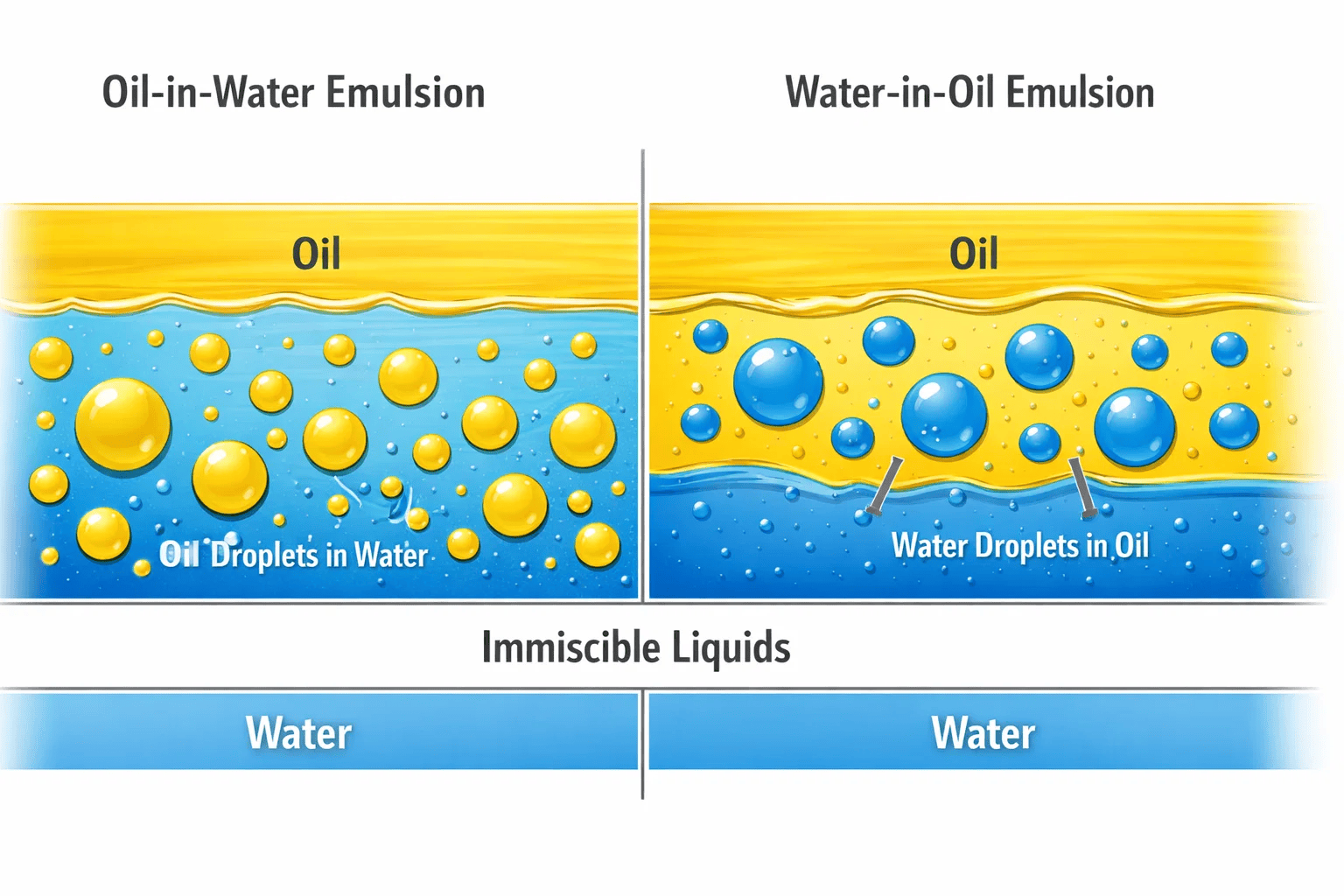
An emulsion is a mixture of two immiscible liquids—typically oil and water—where one liquid is dispersed in the other in the form of tiny droplets.
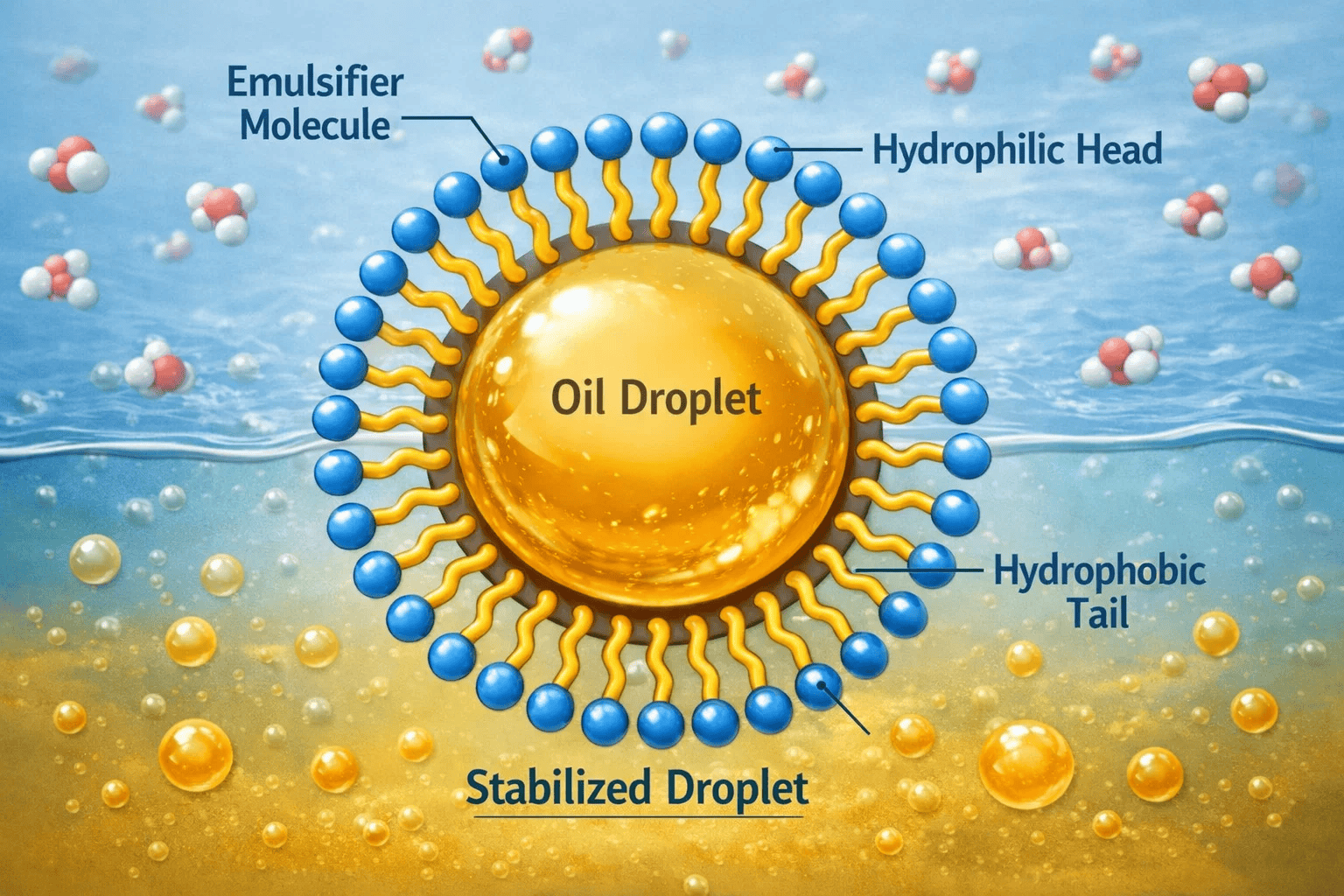
Because oil and water naturally separate, emulsions require stabilizing agents to remain mixed. These agents, known as emulsifiers or surfactants, reduce interfacial tension and form a protective layer around droplets.
There are two primary types of emulsions:
• Oil-in-water (O/W), where oil droplets are dispersed in water
• Water-in-oil (W/O), where water droplets are dispersed in oil
The type of emulsion formed depends on formulation design, surfactant selection, and system conditions.
The Science Behind Emulsion Formation
At the core of emulsion formulation lies interfacial science.
When two immiscible liquids are mixed, energy is required to disperse one phase into the other. This creates droplets, but without stabilization, these droplets quickly merge and separate.
Surfactants play a crucial role by:
• Reducing interfacial tension between oil and water
• Forming a protective film around droplets
• Preventing coalescence and phase separation
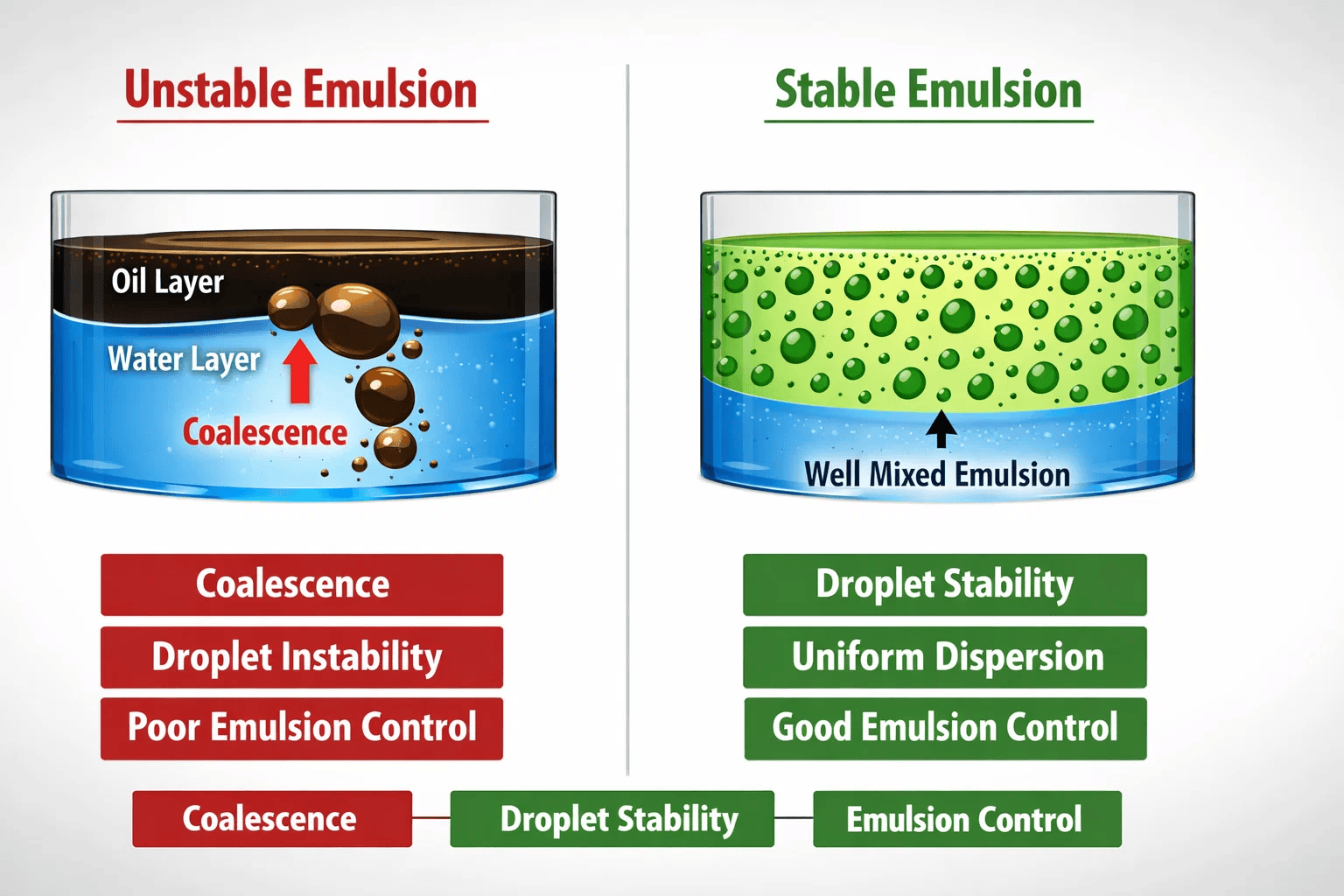
The balance between droplet formation and stabilization determines whether an emulsion remains stable or breaks over time.
Why Emulsion Formulation Matters
In oilfield operations, emulsions can be both beneficial and problematic.
On one hand, stable emulsions are essential in applications such as drilling fluids and chemical delivery systems. On the other hand, unwanted emulsions in production systems can complicate separation and reduce efficiency.
This dual nature makes formulation critical.
A well-designed emulsion system ensures:
Controlled fluid behavior
Improved chemical delivery
Enhanced process efficiency
Reduced operational issues
Poorly formulated emulsions, however, can lead to instability, increased costs, and reduced performance.
Key Components of Emulsion Formulation
Emulsion formulation involves multiple components, each contributing to system stability and performance.
Continuous Phase
This is the liquid in which droplets are dispersed. It can be either oil or water, depending on the type of emulsion.
The choice of continuous phase determines the overall behavior of the system, including viscosity, flow characteristics, and application suitability.
Dispersed Phase
The dispersed phase consists of droplets distributed within the continuous phase. The size and distribution of these droplets significantly influence emulsion stability.
Smaller and more uniform droplets generally result in more stable emulsions.
Emulsifiers (Surfactants)
Emulsifiers are the most critical components in emulsion formulation. They reduce interfacial tension and stabilize droplets by forming a protective layer.
The selection of emulsifiers depends on factors such as:
• Desired emulsion type
• Temperature and pressure conditions
• Compatibility with other chemicals
Additives and Stabilizers
Additional chemicals are often used to enhance performance. These may include viscosity modifiers, salts, or polymers that improve stability and control fluid properties.
These additives help tailor the emulsion to specific operational requirements.
Factors Influencing Emulsion Stability
The stability of an emulsion is influenced by several interconnected factors.
Droplet size distribution plays a major role, as smaller droplets are less likely to coalesce. Temperature can affect both viscosity and interfacial tension, altering stability.
Salinity and pH also impact emulsifier performance, especially in oilfield environments where formation fluids vary significantly.
Mechanical factors such as mixing intensity and shear conditions determine how well the emulsion is initially formed.
A successful formulation must account for all these variables to ensure consistent performance.
The Role of Emulsifiers in Formulation
At the heart of every stable emulsion lies a carefully selected emulsifier system. While oil and water naturally resist mixing, emulsifiers make it possible to create and maintain a stable dispersion by controlling interfacial behavior.
However, not all emulsifiers perform the same way. Their effectiveness depends on chemical structure, system conditions, and compatibility with other components. Choosing the right emulsifier is therefore one of the most critical steps in emulsion formulation.
Types of Emulsifiers
Emulsifiers are broadly categorized based on their chemical nature and mechanism of action. Each type offers specific advantages depending on the application.
Anionic Emulsifiers
Anionic emulsifiers carry a negative charge and are widely used in oilfield and industrial formulations. They provide good stability in systems where electrostatic repulsion between droplets helps prevent coalescence.
These emulsifiers are particularly effective in environments where water quality and salinity can be controlled, allowing them to maintain performance over time.
Cationic Emulsifiers
Cationic emulsifiers carry a positive charge and are often used in systems where interaction with negatively charged surfaces, such as certain rock formations, is beneficial.
Their ability to adsorb onto surfaces makes them useful in applications requiring strong adhesion or surface modification. However, they must be carefully selected to avoid compatibility issues with other chemicals.
Non-Ionic Emulsifiers
Non-ionic emulsifiers do not carry a charge, making them less sensitive to changes in pH and salinity. This makes them highly versatile in oilfield environments where fluid composition can vary significantly.
They are commonly used in formulations that require stability across a wide range of conditions, including high-temperature systems.
Amphoteric Emulsifiers
Amphoteric emulsifiers can carry both positive and negative charges depending on the pH of the system. This adaptability allows them to function effectively in dynamic environments.
They are often used in specialized applications where flexibility and compatibility are critical.
HLB Concept in Emulsion Design
One of the most important principles in emulsion formulation is the Hydrophilic-Lipophilic Balance (HLB).
HLB is a numerical scale that indicates whether an emulsifier is more water-loving (hydrophilic) or oil-loving (lipophilic).
Low HLB emulsifiers tend to form water-in-oil emulsions, while high HLB emulsifiers favor oil-in-water systems.
Selecting the correct HLB value is essential for achieving the desired emulsion type and ensuring long-term stability.
Formulation Design Strategies
Designing an effective emulsion requires more than selecting a single emulsifier. It involves creating a balanced system where all components work together to achieve stability and performance.
Emulsifier Blending
In many cases, a combination of emulsifiers is used instead of a single product. Blending allows formulators to achieve a broader HLB range and improve overall stability.
This approach provides better control over droplet size, distribution, and resistance to coalescence.
Droplet Size Control
Droplet size is a key factor in emulsion stability. Smaller droplets provide a larger surface area, allowing emulsifiers to form a stronger protective layer.
Controlling droplet size requires careful adjustment of mixing energy, shear conditions, and emulsifier concentration.
Phase Volume Optimization
The ratio between the dispersed phase and continuous phase affects emulsion behavior. High dispersed phase volumes can lead to crowding of droplets and increased instability.
Optimizing this ratio ensures that the system remains stable while maintaining desired performance characteristics.
Temperature and Salinity Considerations
Oilfield environments often involve high temperatures and varying salinity levels. These factors can impact emulsifier performance and overall stability.
Formulations must be designed to withstand these conditions without degradation or loss of efficiency.
Compatibility with Other Chemicals
Emulsions rarely exist in isolation. They often interact with other chemicals such as polymers, corrosion inhibitors, and scale inhibitors.
Ensuring compatibility is essential to prevent unwanted reactions, instability, or performance loss.
Balancing Stability and Breakability
One of the most challenging aspects of emulsion formulation is achieving the right balance between stability and breakability.
In some applications, such as drilling fluids, emulsions must remain stable for extended periods. In others, such as production systems, emulsions must eventually break to allow separation.
Designing emulsions that can perform during operation and break when required is a key objective in formulation science.
Application-Specific Formulation
Different oilfield applications require tailored emulsion systems.
Drilling fluids often use stable water-in-oil emulsions to maintain wellbore stability and lubrication. Enhanced oil recovery processes may use emulsions to improve displacement efficiency.
Production systems, on the other hand, require emulsions that can be easily broken to facilitate separation.
This diversity highlights the importance of application-specific formulation design.From Laboratory Design to Field Reality
While emulsion systems can be precisely designed in laboratory conditions, their real performance is tested in the field—where variables are constantly changing. Temperature fluctuations, pressure variations, fluid contamination, and operational dynamics all influence emulsion behavior.
In oilfield operations, emulsions must not only be stable but also adaptable. A formulation that performs well in controlled conditions may behave differently when exposed to real reservoir fluids, shear forces, and chemical interactions.
This makes field application and continuous optimization essential for ensuring reliable performance.
Field Applications of Emulsion Systems
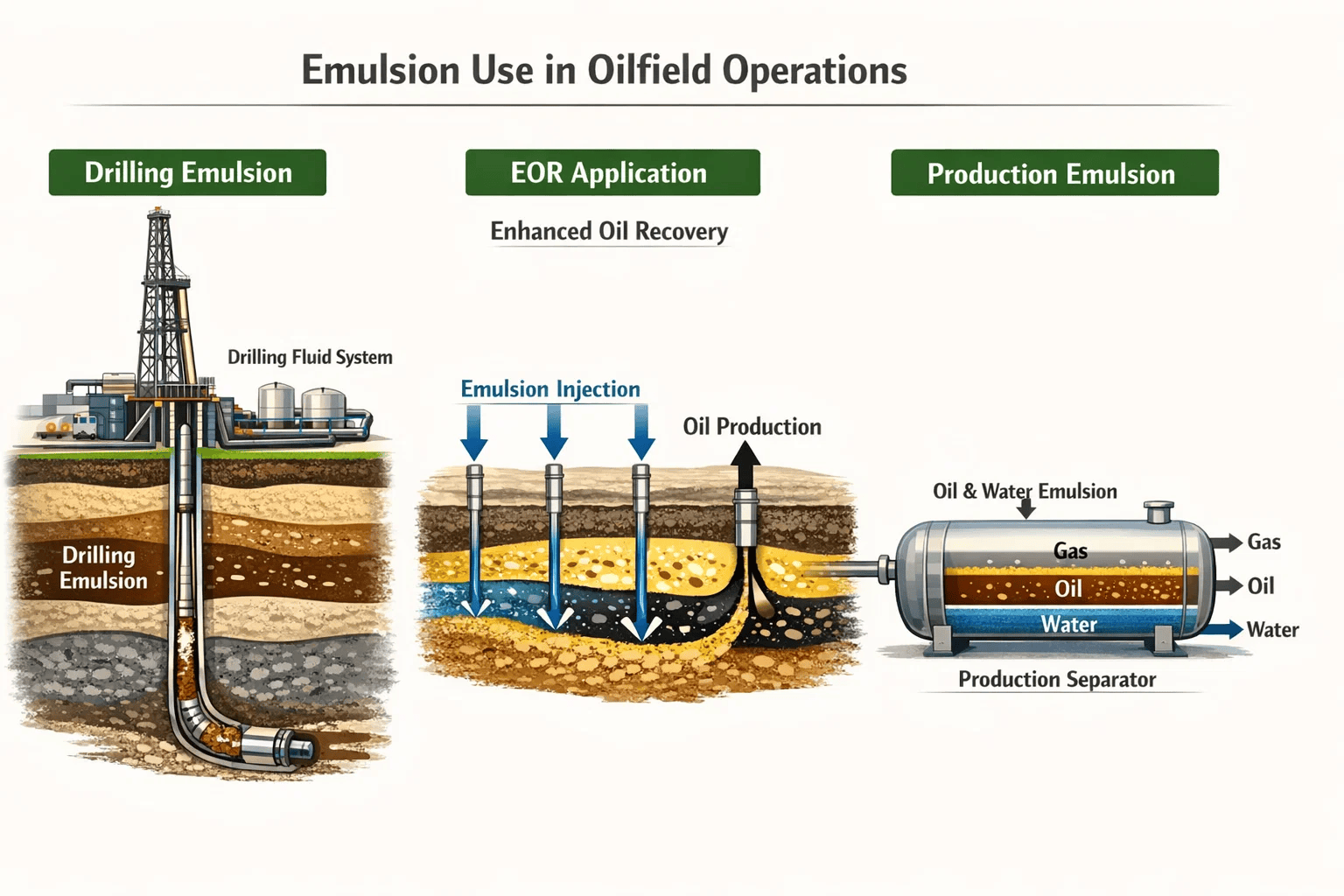
Emulsion systems are widely used across different stages of oilfield operations, each with a specific functional objective.
In drilling operations, water-in-oil emulsions are commonly used to create stable drilling fluids. These systems provide lubrication, improve wellbore stability, and help manage high-pressure conditions.
In enhanced oil recovery processes, emulsions are used to improve displacement efficiency. By modifying fluid properties, they help mobilize trapped oil and improve sweep efficiency across the reservoir.
In stimulation treatments, emulsified acid systems are used to control reaction rates. This allows deeper penetration into the formation, improving treatment effectiveness.
In production systems, emulsions are often encountered as a challenge rather than a solution. Stable oil-water emulsions can reduce separation efficiency and increase processing complexity, requiring demulsification for effective handling.
Operational Challenges in Emulsion Systems
Despite their versatility, emulsion systems face several challenges in real-world operations.
Instability Due to Changing Conditions
Temperature and pressure changes can significantly affect emulsion stability. High temperatures may weaken emulsifier films, while pressure variations can alter droplet behavior.
These changes can lead to phase separation, reduced performance, or inconsistent results.
Contamination from Formation Fluids
Formation fluids often contain salts, minerals, and hydrocarbons that can interact with emulsion systems.
High salinity, for example, can affect emulsifier performance, while the presence of solids can destabilize droplet structures. This makes compatibility a critical factor in formulation design.
Shear and Mechanical Stress
During pumping and circulation, emulsions are subjected to high shear forces. While some level of shear is necessary for droplet formation, excessive shear can break down emulsifier films and destabilize the system.
Maintaining the right balance between mixing and stability is essential.
Difficulty in Controlled Breaking
In production systems, emulsions must eventually be broken to separate oil and water. However, highly stable emulsions can resist demulsification, making separation more difficult and costly.
Designing emulsions that are stable during operation but break when required remains a key challenge.
Monitoring Emulsion Performance
Effective emulsion management requires continuous monitoring of system properties.
Key parameters include droplet size distribution, viscosity, stability over time, and separation behavior. These indicators help determine whether the emulsion is performing as intended or requires adjustment.
Field testing and real-time analysis play an important role in identifying issues early and maintaining system performance.
Optimization Strategies for Emulsion Systems
To ensure consistent performance, emulsion systems must be optimized throughout their lifecycle.
Adaptive Formulation Adjustments
As conditions change, emulsifier concentration and composition may need to be adjusted. This ensures that the system remains stable under varying operational conditions.
Compatibility Testing
Before field application, compatibility tests are conducted with formation fluids and other chemicals. This helps identify potential interactions and avoid performance issues.
Controlled Mixing and Application
Proper mixing techniques and dosing strategies are essential for achieving uniform droplet distribution and stable emulsions.
Injection points, shear conditions, and mixing energy must be carefully controlled.
Integration with Process Design
Emulsion systems should be integrated into the overall process design rather than treated as isolated components. This ensures that they work in harmony with other chemicals and operational parameters.
The Importance of System-Level Thinking
Emulsion behavior is influenced by multiple factors, including chemistry, fluid dynamics, and operational conditions.
A system-level approach ensures that all these factors are considered together, allowing for more effective design and optimization.
This approach reduces the risk of instability, improves efficiency, and enhances overall process performance.
Beyond Mixing: The Strategic Value of Emulsion Formulation
Emulsion formulation is often viewed as a technical process of combining oil and water phases. However, in oilfield operations, it plays a far more strategic role. A well-designed emulsion system directly influences process efficiency, chemical performance, and overall operational reliability.
Whether used intentionally in drilling and stimulation or encountered as a challenge in production systems, emulsions determine how fluids interact, flow, and separate. Their impact extends across the entire oilfield lifecycle.
Operational Benefits of Emulsion Formulation
One of the most important advantages of effective emulsion formulation is controlled fluid behavior. By stabilizing dispersed phases, emulsions allow operators to manage viscosity, flow characteristics, and chemical delivery with precision.
In drilling operations, stable emulsions improve lubrication, enhance wellbore stability, and support efficient cuttings transport. In enhanced oil recovery, emulsified systems can improve displacement efficiency and mobilize trapped hydrocarbons.
Emulsion systems also enable targeted chemical delivery. By dispersing active components within a continuous phase, they ensure that chemicals reach specific zones within the reservoir or wellbore.
Additionally, properly formulated emulsions contribute to process stability, reducing fluctuations and improving consistency in operations.
Economic Impact on Oilfield Operations
The economic value of emulsion formulation lies in its ability to optimize performance while reducing operational risks.
Stable and efficient emulsion systems help minimize issues such as fluid separation, formation damage, and inefficient chemical usage. This reduces non-productive time (NPT) and lowers overall operational costs.
Improved fluid behavior also enhances process efficiency, leading to faster drilling rates, better recovery performance, and more efficient separation in production systems.
Another key economic advantage is optimized chemical consumption. Well-formulated emulsions require lower dosages and deliver better performance, reducing waste and improving cost efficiency.
While formulation development may require investment in testing and design, the long-term benefits in operational efficiency and reliability make it a high-value investment.Role in Complex and Evolving Oilfield Environments
As oilfield operations become more complex, the importance of advanced emulsion systems continues to grow.
In high-pressure, high-temperature (HPHT) environments, emulsions must maintain stability under extreme conditions. This requires advanced emulsifiers and formulation techniques.
In unconventional reservoirs, where fluid behavior can be unpredictable, emulsion systems provide greater control and adaptability.
In enhanced oil recovery processes, emulsions are increasingly being used to improve sweep efficiency and maximize hydrocarbon recovery.
These applications highlight the growing role of emulsion formulation in addressing modern oilfield challenges.
Environmental and Sustainability Considerations
Sustainability is becoming a key focus in oil and gas operations, and emulsion formulation plays a role in achieving environmental goals.
Efficient emulsion systems reduce chemical waste by improving performance at lower dosages. This minimizes the environmental footprint of chemical usage.
Modern formulations are also being developed with more environmentally friendly emulsifiers and additives, aligning with regulatory requirements and sustainability objectives.
Additionally, improved process efficiency reduces energy consumption and waste generation, contributing to more sustainable operations.
However, achieving sustainability requires careful selection, proper dosing, and responsible handling of emulsion systems.
Future Trends in Emulsion Technology
The future of emulsion formulation is driven by innovation in chemistry, material science, and digital technologies.
One of the key trends is the development of advanced surfactant systems that offer improved stability, performance, and environmental compatibility. These next-generation emulsifiers are designed to function effectively under extreme conditions.
Another emerging area is the use of nano-emulsions, where extremely fine droplet sizes enhance stability and improve interaction with reservoir rock. These systems have the potential to significantly improve efficiency in enhanced oil recovery.
Digitalization is also transforming emulsion management. Real-time monitoring and data analytics allow operators to track emulsion behavior and make precise adjustments during operations.
Research into smart and responsive formulations is further expanding possibilities, enabling emulsions that can adapt to changing conditions automatically.
Strategic Importance in Oilfield Chemistry
Emulsion formulation is no longer just a supporting function—it is a core element of oilfield chemistry.
Its ability to influence fluid behavior, chemical performance, and operational efficiency makes it essential for achieving success in modern oilfield operations.
For operators, investing in advanced emulsion systems means:
Improved process control
Enhanced recovery and production efficiency
Reduced operational risks
Better economic outcomes
Conclusion
Emulsion formulation represents a critical intersection of chemistry, engineering, and operational strategy. From stabilizing drilling fluids to enhancing recovery processes and managing production challenges, emulsions play a vital role across the oilfield lifecycle.
Their effectiveness depends on careful design, continuous optimization, and integration with overall process systems. As the industry evolves, advanced emulsion technologies will continue to drive efficiency, sustainability, and innovation.
Ultimately, emulsion formulation is not just about mixing immiscible liquids—it is about creating systems that enable better performance, smarter operations, and greater value in increasingly complex environments.
FAQs (10 Questions)
1. What is emulsion formulation?
Emulsion formulation is the process of creating a stable mixture of two immiscible liquids, typically oil and water, using emulsifiers to control droplet formation and stability.
2. What are the main types of emulsions?
The two primary types are oil-in-water (O/W) and water-in-oil (W/O), depending on which phase is dispersed and which is continuous.
3. Why are emulsifiers important in emulsion formulation?
Emulsifiers reduce interfacial tension and form a protective layer around droplets, preventing them from merging and ensuring stability.
4. What is HLB in emulsion systems?
HLB (Hydrophilic-Lipophilic Balance) is a scale used to determine whether an emulsifier is more suited for oil-in-water or water-in-oil emulsions.
5. Where are emulsions used in oil and gas operations?
They are used in drilling fluids, enhanced oil recovery (EOR), stimulation treatments, and are also encountered in production systems.
6. What causes emulsion instability?
Factors such as temperature changes, salinity, improper emulsifier selection, and mechanical stress can lead to instability and phase separation.
7. How is droplet size important in emulsions?
Smaller and uniformly distributed droplets increase stability and improve overall performance of the emulsion system.
8. Why is emulsion breaking important in production?
In production systems, emulsions must be broken to separate oil and water efficiently, improving processing and crude quality.
9. What are nano-emulsions?
Nano-emulsions are advanced systems with extremely small droplet sizes, offering enhanced stability and improved interaction with reservoir fluids.
10. How do emulsions impact oil recovery?
Properly designed emulsions improve fluid mobility, enhance sweep efficiency, and help recover trapped hydrocarbons.



