
Introduction
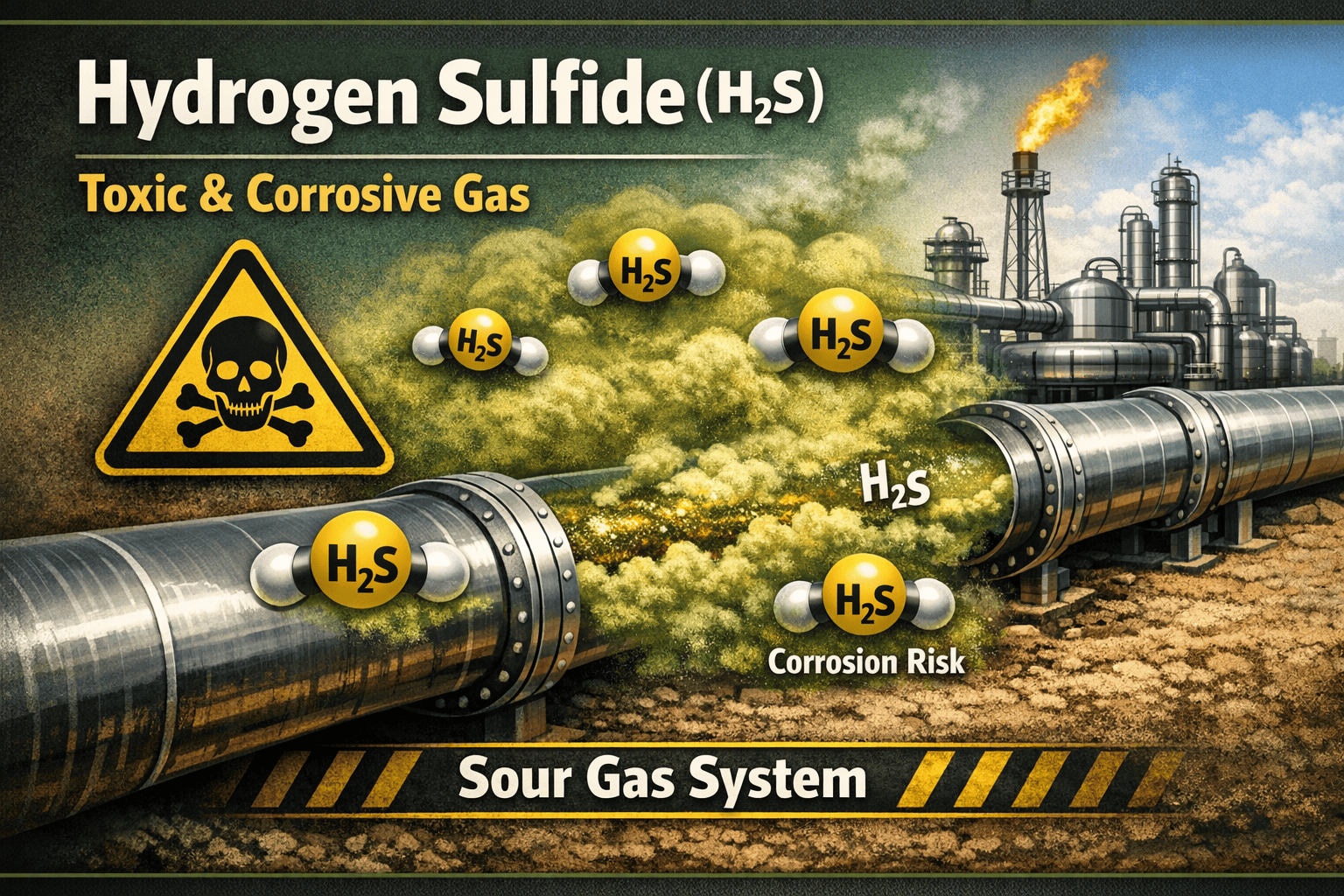
In oil and gas operations, certain challenges are visible—pressure, flow, and production rates. Others, however, are far more dangerous because they remain unseen. Hydrogen sulfide (H₂S) is one such challenge.
Often referred to as “sour gas,” H₂S is a highly toxic and corrosive compound commonly found in hydrocarbon reservoirs. Even at low concentrations, it poses serious risks to human safety, equipment integrity, and overall operational efficiency.
Managing hydrogen sulfide is therefore not optional—it is a critical requirement across upstream, midstream, and processing operations. Among the most effective solutions for controlling H₂S is the use of chemical scavengers.
Hydrogen sulfide scavengers are designed to react with H₂S and convert it into less harmful compounds, enabling safer handling and processing of hydrocarbons. However, not all scavengers are the same. Their performance depends on chemical type, operating conditions, and system requirements.
Understanding the different types of H₂S scavengers begins with understanding the nature of hydrogen sulfide itself.
What is Hydrogen Sulfide (H₂S)?
Hydrogen sulfide is a colorless gas known for its characteristic “rotten egg” smell. It is produced naturally in many reservoirs through biological and chemical processes, particularly in sulfur-rich formations.
Despite its detectability at low levels, H₂S becomes extremely dangerous at higher concentrations, where it can quickly overwhelm human senses and lead to severe health risks.
From an operational perspective, H₂S presents multiple challenges.
It is highly corrosive, especially when combined with water, leading to sulfide stress cracking and material degradation. It also contaminates hydrocarbon streams, affecting product quality and compliance with safety standards.
Because of these risks, strict regulations govern acceptable H₂S levels in oil and gas systems, making its removal a priority.
Why H₂S Removal is Critical
The presence of hydrogen sulfide impacts operations in several ways.
First and most importantly, it poses a serious safety hazard. Even small concentrations can be harmful, while higher levels can be fatal within minutes. Ensuring worker safety requires effective H₂S control at all stages of operation.
Second, H₂S contributes to corrosion and material damage. In the presence of moisture, it forms acidic compounds that attack metal surfaces, reducing equipment life and increasing maintenance costs.
Third, it affects product quality and compliance. Many pipelines and processing facilities have strict limits on H₂S content. Exceeding these limits can prevent hydrocarbons from being transported or sold.
Finally, H₂S can interfere with downstream processes, including refining and gas treatment, making its removal essential for overall system efficiency.
What are H₂S Scavengers?
Hydrogen sulfide scavengers are chemical agents that react with H₂S to neutralize or remove it from hydrocarbon streams.
Unlike large-scale treatment systems such as amine units, scavengers are often used for localized, flexible, and cost-effective H₂S control.
They are widely applied in:
• Wellhead and production systems
• Pipelines and storage tanks
• Drilling fluids and completion fluids
• Temporary or mobile treatment setups
Scavengers work by converting H₂S into stable, non-volatile compounds, preventing it from causing harm.
How H₂S Scavengers Work
The effectiveness of a scavenger depends on its ability to chemically react with hydrogen sulfide.
In most cases, the scavenger reacts with H₂S to form:
• Non-toxic compounds
• Insoluble solids or stable liquids
• Products that can be safely handled or removed
The reaction must be fast, efficient, and compatible with the system conditions.
Different scavengers use different reaction mechanisms, which is why selecting the right type is critical.
Key Factors in Selecting H₂S Scavengers
Choosing the appropriate scavenger requires careful consideration of multiple factors.
The phase of the system—whether gas, liquid, or multiphase—affects how the scavenger interacts with H₂S.
Temperature and pressure conditions influence reaction rates and chemical stability. Higher temperatures may accelerate reactions but can also affect chemical integrity.
The concentration of H₂S determines the required dosage and type of scavenger.
Compatibility with other chemicals and system components is also essential to avoid unwanted reactions or performance issues.
These factors highlight the importance of application-specific selection rather than a one-size-fits-all approach.
Limitations of Generic Treatment Approaches
While H₂S scavengers are highly effective, using the wrong type or dosage can lead to inefficiencies.
Some scavengers may react too slowly, leaving residual H₂S in the system. Others may produce by-products that cause fouling or deposition.
Overdosing can increase costs without improving performance, while underdosing can compromise safety.
This makes it essential to understand the different types of scavengers and their specific applications.
Moving Beyond Basics: Why Types Matter
While all hydrogen sulfide scavengers serve the same purpose—removing H₂S—their chemical nature, reaction speed, and by-products vary significantly.
Selecting the right scavenger is not just about availability; it is about matching the chemistry to the operating environment. Different systems—gas, liquid, or multiphase—require different approaches.
Understanding the major categories of scavengers helps in designing more efficient and reliable H₂S control strategies.
Triazine-Based Scavengers
One of the most widely used categories in oilfield operations is triazine-based scavengers.
These are typically liquid-phase chemicals that react rapidly with hydrogen sulfide. The reaction converts H₂S into stable compounds, making it suitable for production systems and liquid hydrocarbon streams.
Mechanism of Action
Triazine molecules react with H₂S through a substitution reaction, forming non-volatile by-products.
This reaction is:
• Fast and efficient
• Effective in liquid systems
• Suitable for continuous injection
Applications and Considerations
Triazine scavengers are commonly used in:
• Produced fluids
• Storage tanks
• Pipeline treatment
However, one important consideration is the formation of solid by-products over time, which can lead to fouling if not properly managed.
Metal-Based Scavengers
Metal-based scavengers, such as iron or zinc compounds, operate through a different mechanism.
Instead of forming liquid products, they react with H₂S to form metal sulfides, which are typically insoluble solids.
Mechanism of Action
The reaction involves direct binding of H₂S with metal ions, producing stable solid compounds.
This approach is:
• Highly effective for removing H₂S
• Suitable for both gas and liquid systems
• Often used in batch or fixed-bed applications
Applications and Considerations
Metal-based scavengers are widely used in:
• Gas treatment systems
• Solid scavenger beds
• Drilling and completion fluids
While effective, they require handling of solid by-products and disposal management.
Aldehyde-Based Scavengers
Aldehyde-based scavengers represent another class of H₂S treatment chemicals.
These compounds react chemically with hydrogen sulfide to form stable, non-toxic products.
Mechanism of Action
Aldehydes react with H₂S through addition reactions, converting it into less harmful compounds.
This reaction is:
• Fast under controlled conditions
• Effective in both liquid and multiphase systems
Applications and Considerations
They are often used in:
• Production systems
• Pipeline treatments
• Temporary H₂S control applications
However, careful selection and dosing are required to ensure compatibility and avoid unwanted reactions.
Amine-Based Scavengers (Hybrid Systems)
While amine systems are typically associated with large-scale gas treatment units, certain amine-based chemicals are also used as scavenging agents in smaller or hybrid applications.
Mechanism of Action
Amines react with H₂S to form soluble compounds, enabling removal from the gas stream.
This mechanism is:
• Reversible in some cases
• Effective for controlled environments
Applications and Considerations
Amine-based scavengers are used in:
• Gas sweetening support systems
• Hybrid treatment setups
• Situations requiring controlled absorption
They are less common as standalone scavengers but play a role in integrated systems.
Solid Scavengers (Fixed Bed Systems)
Solid scavengers are used in systems where continuous liquid injection is not practical.
These are typically metal oxide-based materials packed in vessels through which gas flows.
Mechanism of Action
As gas passes through the bed, H₂S reacts with the solid material, forming stable sulfides.
This approach offers:
• High removal efficiency
• No liquid handling requirements
• Suitability for gas streams
Applications and Considerations
Solid scavengers are commonly used in:
• Gas processing units
• Remote or offshore installations
• Low-maintenance systems
However, once saturated, the material must be replaced or regenerated.
Comparing Scavenger Types
Each type of scavenger offers unique advantages depending on system conditions.
Triazines are fast and versatile but may create solids over time.
Metal-based scavengers are highly effective but require handling of solid by-products.
Aldehydes provide flexibility but require careful control.
Solid scavengers are ideal for gas systems but need periodic replacement.
The choice depends on factors such as:
• Phase of operation (gas vs liquid)• H₂S concentration
• Operational constraints
• Environmental considerations
Importance of Mechanism-Based Selection
Selecting a scavenger based solely on cost or availability can lead to inefficiencies.
A mechanism-based approach ensures that the chosen chemical:
• Reacts efficiently under given conditions
• Minimizes unwanted by-products
• Integrates well with the overall system
This improves both safety and operational performance.
From Chemistry to Operations
Understanding scavenger types and mechanisms is only the first step. In real-world oilfield environments, performance depends on how effectively these chemicals are applied under dynamic and often unpredictable conditions.
Hydrogen sulfide levels can fluctuate with production rates, reservoir behavior, and fluid composition. This makes H₂S control not a one-time treatment, but a continuous operational strategy.
Field Applications of H₂S Scavengers
H₂S scavengers are used across multiple stages of oil and gas operations, each with specific requirements.
In upstream production, scavengers are injected at the wellhead or into flowlines to control H₂S as it is produced. This ensures safer handling of fluids from the earliest stage.
In midstream systems, scavengers are used in pipelines and storage tanks to maintain acceptable H₂S levels and meet transportation specifications.
In gas processing operations, scavengers are often applied as supplementary treatments to remove residual H₂S that may not be captured by primary systems.
In drilling and completion fluids, scavengers help manage H₂S encountered during well construction, protecting both personnel and equipment.
These diverse applications highlight the flexibility and importance of scavenger systems.
Operational Challenges in H₂S Scavenging
Despite their effectiveness, H₂S scavengers face several challenges in field conditions.
Variability in H₂S Concentration
H₂S levels can change rapidly due to reservoir conditions or operational factors.
This variability makes it difficult to maintain consistent treatment, especially if dosing is not adjusted in real time.
Phase Interaction Issues
H₂S can exist in gas, liquid, or multiphase systems.
A scavenger that works well in liquid may not perform effectively in gas, and vice versa. Ensuring proper contact between scavenger and H₂S is critical for reaction efficiency.
By-Product Formation
Some scavengers produce solid or semi-solid by-products during reaction.
If not managed properly, these by-products can:
• Accumulate in pipelines
• Cause fouling or blockages
• Affect downstream equipment
This is particularly important in continuous injection systems.
Chemical Compatibility
Scavengers must coexist with other chemicals such as corrosion inhibitors, demulsifiers, and scale inhibitors.
Incompatibility can lead to:
• Reduced effectiveness of treatments
• Formation of unwanted compounds
• Instability in fluid systems
Environmental and Safety Considerations
Handling and disposal of reaction by-products must comply with environmental regulations.
Additionally, improper dosing or system failure can lead to exposure risks, making safety a key concern.
Monitoring and Performance Control
Effective H₂S management requires continuous monitoring of system conditions.
Operators typically track:
• H₂S concentration levels
• Scavenger injection rates
• Reaction efficiency
• System pressure and temperature
Monitoring allows for timely adjustments, ensuring that H₂S levels remain within safe limits.
Advanced systems may incorporate real-time sensors and automated dosing to improve accuracy and response time.
Optimization Strategies for Scavenger Systems
To achieve reliable performance, H₂S scavenger systems must be optimized based on operating conditions.
Correct Scavenger Selection
Choosing the right type of scavenger for the specific phase and application is the foundation of effective treatment.
Optimized Injection Points
Proper placement of injection points ensures maximum contact between scavenger and H₂S.
For example, injecting at locations with high turbulence improves mixing and reaction efficiency.
Controlled Dosing
Maintaining the correct dosage is critical.
Overdosing increases cost and may create excess by-products, while underdosing leaves residual H₂S in the system.
By-Product Management
Systems must be designed to handle and remove reaction by-products to prevent fouling and maintain flow efficiency.
Integration with Overall Chemical Program
H₂S scavenging should be integrated with corrosion control, flow assurance, and production chemistry programs.
This ensures that all treatments work together rather than interfering with each other.
Importance of System-Level Approach
H₂S control is not an isolated activity—it is part of a broader chemical management strategy.
A system-level approach considers:
• Interaction between chemicals
• Process conditions across the operation
• Long-term performance and maintenance
This approach improves efficiency, reduces risks, and enhances overall operational reliability.
Beyond Treatment: Strategic Importance of H₂S Scavenging
Hydrogen sulfide scavenging is often seen as a corrective measure—something used to remove a harmful gas from the system. In reality, it is a strategic operational tool that directly impacts safety, asset integrity, and production continuity.
Effective H₂S control enables operators to maintain safe working environments, protect infrastructure, and ensure that hydrocarbons meet transport and processing specifications. Its value extends far beyond simple gas removal.
Operational Benefits of H₂S Scavenger Systems
One of the most critical benefits of H₂S scavengers is enhanced safety. By reducing hydrogen sulfide levels, these systems help prevent exposure risks and create safer working conditions across operations.
Another major advantage is corrosion control. H₂S is a key contributor to sulfide stress cracking and material degradation. Removing it from the system significantly reduces corrosion rates and extends equipment life.
H₂S scavengers also support consistent product quality. By maintaining acceptable H₂S levels, operators can meet pipeline and regulatory standards, ensuring uninterrupted transport and sale of hydrocarbons.
Additionally, scavenger systems provide operational flexibility. They can be deployed quickly, scaled as needed, and adapted to different system conditions, making them suitable for both temporary and long-term applications.
Economic Impact on Oilfield Operations
The economic benefits of H₂S scavenging are closely tied to risk reduction and operational efficiency.
Uncontrolled H₂S can lead to equipment failure, production shutdowns, and costly maintenance. By preventing these issues, scavenger systems help reduce non-productive time and avoid expensive repairs.
Corrosion-related damage is one of the most significant cost drivers in oilfield operations. Effective H₂S removal minimizes these risks, leading to lower maintenance and replacement costs.
Scavenger systems also improve chemical efficiency. Properly selected and dosed scavengers ensure that treatment is effective without excessive chemical usage, optimizing cost-performance balance.
While there is a cost associated with chemical injection, the overall savings in avoided failures and improved efficiency make H₂S scavenging a cost-effective solution.Environmental and Regulatory Considerations
Hydrogen sulfide is not only a safety hazard but also an environmental concern. Its release into the atmosphere must be strictly controlled.
H₂S scavenger systems help operators meet environmental regulations by reducing emissions and ensuring safe handling of sour hydrocarbons.
Modern scavenger formulations are designed to minimize harmful by-products and improve environmental compatibility. However, responsible handling and disposal of reaction products remain essential.
Regulatory compliance increasingly requires accurate monitoring and reporting of H₂S levels, making effective scavenging systems a key component of environmental management.
Challenges in Sustainability
Despite their benefits, H₂S scavenger systems must address certain sustainability challenges.
Some scavengers produce solid by-products that require proper disposal. Managing these materials adds complexity to operations.
Chemical consumption and transportation also contribute to environmental impact, emphasizing the need for efficient dosing and system optimization.
Balancing performance with environmental responsibility is a key focus for the industry.
Future Trends in H₂S Scavenger Technology
The future of H₂S scavenging is being shaped by innovation in chemistry and process optimization.
One major trend is the development of high-efficiency scavengers that provide faster reaction rates with reduced by-product formation.
Advancements in low-solids and non-fouling formulations are helping address challenges related to deposition and system blockage.
Digitalization is also playing a role, with real-time monitoring and automated dosing systems enabling more precise control of H₂S levels.
Integration with broader chemical management systems is improving overall efficiency and reducing operational risks.
Research into environmentally friendly and biodegradable scavengers is further driving sustainability in H₂S control.
Strategic Role in Modern Oilfield Operations
H₂S scavenger systems are no longer just supplementary treatments—they are an integral part of modern oilfield operations.
Their ability to ensure safety, protect assets, and maintain production efficiency makes them essential for successful operations.
For operators, investing in advanced scavenger systems means:
Improved safety standardsReduced operational risks
Enhanced asset longevity
Better economic performance
Conclusion
Hydrogen sulfide remains one of the most critical challenges in oil and gas operations. Its impact on safety, equipment, and production makes effective control essential.
H₂S scavengers provide a flexible and efficient solution, capable of adapting to a wide range of operating conditions. Their effectiveness depends on proper selection, system design, and continuous optimization.
As the industry evolves, advancements in technology and sustainability will continue to enhance the role of scavenger systems, ensuring safer and more efficient operations.
Ultimately, H₂S scavenging is not just about removing a gas—it is about enabling reliable, compliant, and high-performance oilfield operations.
FAQs
1. What is a Hydrogen Sulfide (H₂S) scavenger?
An H₂S scavenger is a chemical used to react with hydrogen sulfide and convert it into non-toxic or less harmful compounds, ensuring safe oil and gas operations.
2. Why is H₂S removal important in oil and gas?
H₂S is highly toxic and corrosive. Its removal is critical for worker safety, equipment protection, and meeting regulatory and pipeline specifications.
3. What are the main types of H₂S scavengers?
Common types include triazine-based, metal-based, aldehyde-based, amine-based, and solid scavengers used in fixed-bed systems.
4. How do triazine scavengers work?
Triazine scavengers react with H₂S to form stable, non-volatile compounds, making them effective for liquid-phase applications.
5. What are metal-based scavengers used for?
Metal-based scavengers react with H₂S to form solid metal sulfides and are often used in gas systems or fixed-bed applications.
6. Can H₂S scavengers be used in gas systems?
Yes, certain scavengers, especially solid and gas-phase compatible types, are specifically designed for gas treatment applications.
7. What challenges occur when using H₂S scavengers?
Common challenges include by-product formation, chemical compatibility issues, dosing control, and variability in H₂S concentration.
8. How is the right scavenger selected?
Selection depends on system phase (gas/liquid), H₂S concentration, temperature, pressure, and compatibility with other chemicals.
9. Do H₂S scavengers cause fouling?
Some scavengers can produce solid by-products that may lead to fouling if not properly managed.
10. Are H₂S scavengers environmentally safe?
Modern scavengers are designed to be safer and more environmentally compliant, but proper handling and disposal are still required.



