
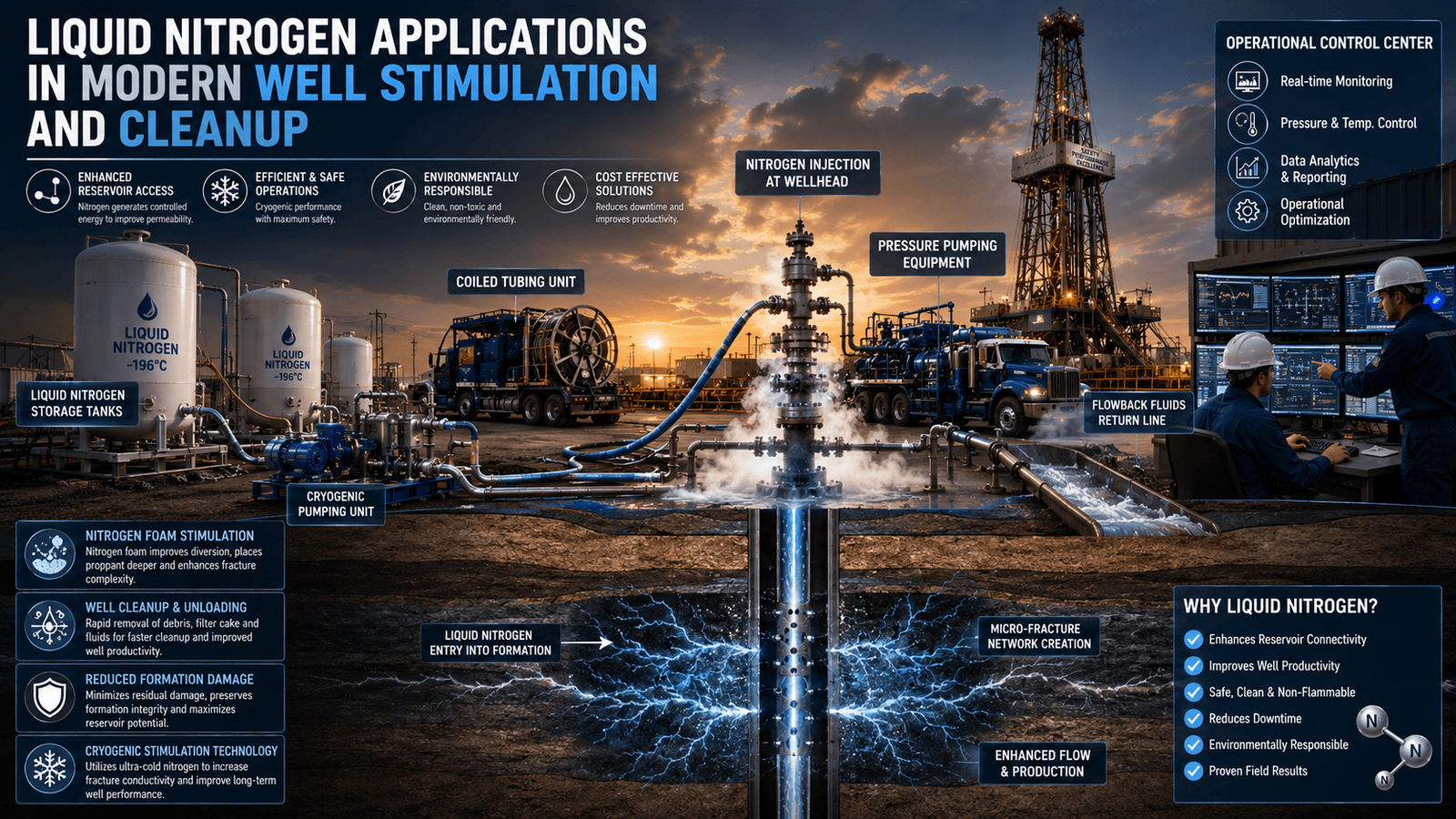
Introduction
As oil and gas reservoirs become increasingly complex, the industry continues searching for stimulation methods that improve production while minimizing formation damage. Conventional fluid-based stimulation systems have delivered significant results for decades, but they also introduce operational challenges such as water sensitivity, formation impairment, and cleanup inefficiencies.
This has led to growing interest in alternative stimulation technologies that can enhance productivity without negatively impacting the reservoir. Among these technologies, liquid nitrogen has emerged as one of the most versatile and effective solutions in modern oilfield operations.
Liquid nitrogen is no longer used only as a support fluid or auxiliary treatment. Today, it plays a critical role in well stimulation, cleanup operations, underbalanced drilling, and production enhancement strategies.
Its unique physical properties allow operators to improve well performance while reducing liquid loading, minimizing formation damage, and accelerating cleanup efficiency.
Understanding how liquid nitrogen works and why it has become important in modern well operations provides insight into the future direction of stimulation technology.
What is Liquid Nitrogen?
Liquid nitrogen is nitrogen gas cooled to an extremely low temperature of approximately −196°C (-320°F), converting it into a cryogenic liquid state.
In this form, nitrogen becomes highly dense and transportable. Once exposed to warmer conditions, it rapidly expands back into gas.
One liter of liquid nitrogen can expand into nearly 700 liters of nitrogen gas, creating significant energy and pressure potential.
This rapid phase transformation is what makes liquid nitrogen highly effective in oilfield stimulation and cleanup applications.
Why Nitrogen is Important in Oilfield Operations
Nitrogen is an inert gas, meaning it does not readily react with hydrocarbons, reservoir minerals, or most stimulation chemicals.
This non-reactive nature makes it valuable in sensitive formations where chemical compatibility and formation preservation are critical.
Unlike water-based systems, nitrogen introduces minimal liquid into the reservoir, reducing the risk of:
• Clay swelling
• Water blocking
• Formation damage
• Reduced permeability
This characteristic has become increasingly important in low-pressure reservoirs and water-sensitive formations.
Physical Properties That Make Liquid Nitrogen Valuable
The effectiveness of liquid nitrogen is directly linked to its physical behavior under downhole conditions.
Rapid Expansion Capability
As liquid nitrogen warms, it rapidly expands into gas. This expansion generates energy that helps lift fluids, improve flowback, and clean wellbores efficiently.
The expansion effect also creates agitation and turbulence inside the formation, helping mobilize trapped materials.
Cryogenic Cooling Effect
The extremely low temperature of liquid nitrogen creates thermal stress when introduced into reservoir rock.
This thermal shock can generate micro-fractures within the formation, improving permeability and fluid flow pathways.
The effect is particularly useful in tight formations where conventional stimulation methods may struggle to achieve sufficient conductivity.
Low Residue Characteristics
Unlike many fluid-based treatments, nitrogen leaves virtually no residue inside the formation.
This improves cleanup efficiency and minimizes post-treatment impairment.
For operators, this means faster return to production and improved well performance.
Lightweight Nature
Nitrogen has significantly lower density than conventional stimulation fluids.
This reduces hydrostatic pressure inside the wellbore, making it useful for:
• Low-pressure wells
• Depleted reservoirs
• Underbalanced operations
Reducing fluid pressure can help prevent additional damage to fragile formations.
Evolution of Nitrogen-Based Stimulation
Nitrogen has been used in oilfield operations for decades, initially in basic lifting and unloading applications.
Over time, advancements in pumping technology, cryogenic handling systems, and stimulation design have expanded its role considerably.
Modern nitrogen applications now include:
• Foam fracturing
• Acid stimulation support
• Well unloading
• Sand cleanout
• Coiled tubing operations
• Underbalanced drilling
Today, nitrogen is considered an essential component in many advanced stimulation programs.
Liquid Nitrogen vs Conventional Fluid Systems
Traditional stimulation fluids are effective in many reservoirs, but they can introduce challenges related to water compatibility and cleanup.
Liquid nitrogen offers several operational advantages:
Reduced Formation Damage
Because nitrogen introduces minimal liquid, it lowers the risk of water-related impairment.
Faster Cleanup
Gas expansion helps rapidly recover fluids and debris from the wellbore.
Improved Stimulation Efficiency
Nitrogen-assisted systems can improve acid placement and fracture conductivity.
Better Performance in Low-Pressure Reservoirs
The lightweight nature of nitrogen reduces hydrostatic loading and supports production recovery.
Importance in Modern Well Cleanup Operations
Well cleanup is one of the most critical stages after stimulation or drilling operations.
Residual fluids, solids, and debris can restrict production and delay well startup.
Liquid nitrogen helps improve cleanup by:
• Energizing fluid recovery
• Assisting debris transport
• Enhancing flowback efficiency
• Reducing liquid loading
This makes it particularly valuable in mature and depleted reservoirs.
Operational Safety and Handling Considerations
Despite its advantages, liquid nitrogen requires specialized handling due to its cryogenic nature.
Proper insulation, pressure management, and safety protocols are essential during transportation and field operations.
Rapid vaporization can create high-pressure conditions, requiring careful operational control.
As nitrogen usage expands, safety and handling expertise become increasingly important.
From Cryogenic Fluid to Stimulation Tool
While the physical properties of liquid nitrogen make it technically impressive, its true importance lies in how effectively those properties are used in field operations.
Modern well stimulation and cleanup programs increasingly rely on nitrogen not merely as a support fluid, but as an active component in improving production efficiency, minimizing formation damage, and accelerating well recovery.
Its ability to expand rapidly, reduce hydrostatic pressure, and energize fluid systems has made liquid nitrogen a highly adaptable solution across multiple oilfield applications.
Nitrogen-Assisted Acid Stimulation
One of the most common applications of liquid nitrogen is in acid stimulation treatments.
Acidizing operations are designed to dissolve formation damage, open flow channels, and improve permeability. However, conventional acid systems can sometimes struggle with fluid recovery and cleanup, especially in low-pressure formations.
Nitrogen helps address these limitations.
When liquid nitrogen is combined with acid systems, it creates an energized treatment environment that improves fluid movement and post-treatment cleanup.
The expanding nitrogen gas assists in:
• Recovering spent acid from the formation
• Reducing liquid retention inside pore spaces
• Enhancing acid placement
• Improving stimulation efficiency
This reduces the risk of water blocking and improves the speed of production recovery after treatment.
Nitrogen Foam Fracturing
Foam fracturing is one of the most advanced nitrogen-based stimulation methods used in modern reservoirs.
In this process, nitrogen is combined with fracturing fluids and foaming agents to create a foam system with lower liquid content than conventional hydraulic fracturing fluids.
These foam systems offer several operational advantages.
Reduced Water Usage
Foam fracturing significantly reduces the amount of water introduced into the reservoir.
This is particularly important in:
• Water-sensitive formations
• Tight reservoirs
• Regions with water availability concerns
Lower water volumes also improve environmental efficiency.
Improved Cleanup Efficiency
Nitrogen foam breaks down after treatment, allowing gas expansion to assist in fluid recovery.
This improves fracture cleanup and reduces residual fluid damage inside the formation.
Better Proppant Transport
Foam systems can effectively transport proppants while maintaining lower fluid density.
This helps improve fracture conductivity and production performance.
Well Unloading and Kickoff Operations
Liquid loading is a common challenge in mature gas wells and depleted reservoirs.
Over time, accumulated fluids create hydrostatic pressure that restricts gas flow and prevents the well from producing efficiently.
Liquid nitrogen is frequently used for well unloading operations because its rapid expansion helps lift accumulated fluids to the surface.
The process works by:
• Reducing hydrostatic pressure
• Energizing the wellbore
• Creating upward fluid movement
• Assisting gas flow recovery
This can restore production without requiring major mechanical intervention.
Nitrogen kickoffs are especially valuable in wells that cannot naturally initiate flow after completion or workover operations.
Sand and Debris Cleanout Operations
After drilling, fracturing, or stimulation treatments, wells often contain residual solids such as sand, scale, or debris.
These materials can restrict flow paths and damage production equipment.
Nitrogen-assisted cleanout operations use gas expansion to improve debris transport and removal.
Combined with coiled tubing systems, liquid nitrogen helps:
• Mobilize solids from the wellbore
• Reduce fluid loading during cleanout
• Improve lifting efficiency
• Enhance operational safety in low-pressure wells
This makes nitrogen particularly useful in sensitive or depleted formations where conventional circulation methods may create excessive pressure.
Coiled Tubing Nitrogen Operations
Coiled tubing and nitrogen are commonly used together in intervention and stimulation operations.
Nitrogen improves the efficiency of coiled tubing services by reducing bottomhole pressure and improving circulation performance.
Applications include:
• Acid placement
• Scale removal
• Wellbore cleanup
• Flow initiation
• Pressure reduction during intervention
The combination provides operators with a flexible and efficient well intervention solution.
Underbalanced Drilling Applications
Liquid nitrogen also plays an important role in underbalanced drilling operations.
In conventional drilling, excessive hydrostatic pressure can force drilling fluids into the formation, causing damage and reducing productivity.
Nitrogen helps reduce the density of drilling fluids, enabling underbalanced conditions where formation pressure remains higher than wellbore pressure.
This approach offers several advantages:
• Reduced formation damage
• Improved rate of penetration
• Better reservoir preservation
• Lower fluid invasion risk
Underbalanced drilling is especially valuable in depleted or fragile formations.
Operational Design Consideration
Although nitrogen-based operations offer significant benefits, their success depends heavily on proper engineering and treatment design.
Several factors must be evaluated before application:
Reservoir Pressure and Temperature
Nitrogen behavior changes under varying pressure and temperature conditions. Accurate modeling is necessary to predict expansion and fluid dynamics.
Formation Characteristics
Reservoir permeability, clay sensitivity, and fracture behavior influence the effectiveness of nitrogen treatments.
Fluid Compatibility
Nitrogen must be compatible with acids, foaming agents, and other treatment chemicals used during operations.
Pumping and Pressure Control
Cryogenic pumping systems require specialized equipment and precise pressure management to ensure operational safety and treatment effectiveness.
Advantages Over Conventional Cleanup Methods
Compared to conventional fluid-heavy operations, nitrogen-based systems offer several advantages:
• Lower formation damage risk
• Faster cleanup and flowback
• Reduced liquid loading
• Improved stimulation recovery
• Better performance in low-pressure wells
These benefits have made nitrogen a preferred solution in many challenging reservoir conditions.
Operational Benefits of Liquid Nitrogen
The growing adoption of nitrogen-based systems is driven by the unique operational benefits they offer across drilling, stimulation, and cleanup applications.
Reduced Formation Damage
One of the biggest advantages of liquid nitrogen is its low-liquid nature.
Conventional water-based treatments can create issues such as:
• Clay swelling
• Water blocking
• Reduced permeability
• Fluid trapping inside pore spaces
Nitrogen significantly reduces these risks because it introduces minimal liquid into the reservoir.
This makes it especially beneficial in:
• Tight gas formations
• Water-sensitive reservoirs
• Low-pressure wells
• Mature and depleted fields
Preserving formation integrity directly contributes to improved long-term production performance.
Faster Well Cleanup and Recovery
Nitrogen’s rapid gas expansion creates strong lifting and flowback capability.
This accelerates the recovery of:
• Spent acids
• Fracturing fluids
• Sand and debris
• Residual liquids
As a result, wells often return to production faster compared to conventional cleanup methods.
Improved cleanup efficiency also reduces post-treatment impairment and operational downtime.
Enhanced Stimulation Efficiency
Nitrogen-assisted stimulation systems improve the effectiveness of acidizing and fracturing operations.
The energized nature of nitrogen foam systems enhances:
• Acid penetration
• Fracture cleanup
• Proppant placement
• Fluid distribution inside the formation
This improves the overall efficiency of stimulation treatments.
Lower Hydrostatic Pressure
Because nitrogen is lightweight, it helps reduce bottomhole pressure during operations.
Lower hydrostatic pressure supports:
• Better fluid recovery
• Reduced fluid invasion
• Improved production startup
This advantage is particularly important in depleted reservoirs where excessive pressure can severely damage productivity.
Economic Advantages of Nitrogen-Based Operations
Beyond technical performance, liquid nitrogen can also provide significant economic benefits.
Reduced Water Handling Costs
Conventional stimulation systems require large volumes of water, leading to:
• Transportation expenses
• Storage requirements
• Disposal and treatment costs
Nitrogen foam systems reduce water dependency, lowering overall operational costs in certain applications.
Reduced Non-Productive Time (NPT)
Faster cleanup and production recovery reduce downtime between treatment and production phases.
This directly improves operational efficiency and well economics.
Improved Reservoir Productivity
By minimizing formation damage and enhancing stimulation efficiency, nitrogen-assisted treatments can increase hydrocarbon recovery and extend well productivity.
In mature fields, even modest improvements in production can create substantial economic value.
Operational Challenges and Limitations
Despite its benefits, liquid nitrogen operations are technically demanding and involve several challenges.
Cryogenic Handling Complexity
Liquid nitrogen must be stored and transported at extremely low temperatures.
This requires specialized:
• Insulated storage systems
• Cryogenic pumps
• Pressure-control equipment
• Safety protocols
Handling errors can create operational and safety risks.
High Equipment and Logistics Costs
Nitrogen operations require dedicated pumping units, storage tanks, vaporizers, and transportation systems.
In remote locations, logistics can significantly increase operational expenses.
The economic viability of nitrogen stimulation therefore depends on reservoir conditions and treatment objectives.
Pressure Management Challenges
Rapid nitrogen expansion creates high-pressure dynamics that must be carefully controlled.
Improper pressure management can result in:
• Equipment stress
• Treatment instability
• Inefficient placement
Engineering design and real-time monitoring are critical for safe operations.
Limited Effectiveness in Certain Reservoirs
While nitrogen performs exceptionally well in many formations, it may not always be the ideal solution.
Reservoirs requiring high fluid volumes or specific fracture geometries may still depend on conventional stimulation methods.
Nitrogen treatments must therefore be selected based on detailed reservoir evaluation.
Environmental Considerations
As sustainability becomes increasingly important in the energy sector, nitrogen-based systems offer several environmental advantages.
Reduced Water Consumption
Lower water usage reduces strain on local water resources and minimizes wastewater generation.
Reduced Chemical Residue
Nitrogen leaves little to no residue inside the formation, improving environmental compatibility.
Lower Disposal Requirements
Reduced liquid volumes decrease disposal and treatment needs after operations.
These advantages align with the industry’s broader focus on environmentally responsible stimulation practices.
Technological Advancements Driving Future Growth
The future of liquid nitrogen stimulation is being shaped by ongoing technological innovation.
Advanced Foam Systems
Modern foam formulations are improving stability, proppant transport, and stimulation efficiency.
These systems allow nitrogen-assisted treatments to perform in increasingly complex reservoirs.
Digital Monitoring and Modeling
Real-time monitoring and simulation tools now help operators:
• Predict nitrogen behavior
• Optimize pumping schedules
• Improve pressure control
• Enhance treatment accuracy
Data-driven optimization is improving both safety and efficiency.
Integration with Hybrid Stimulation Systems
Future stimulation programs are likely to combine nitrogen with:
• Advanced acids
• Specialized surfactants
• Low-damage fluid systems
• Smart chemical additives
This integration will create more targeted and reservoir-specific stimulation strategies.
Role in Unconventional Reservoir Development
As unconventional resource development expands globally, nitrogen-based stimulation is becoming increasingly relevant.
Shale reservoirs and tight formations often require:
• Reduced water exposure
• Improved cleanup efficiency
• Low-damage stimulation systems
Nitrogen is well positioned to support these operational requirements.
Industry Outlook
The global oil and gas industry is gradually shifting toward stimulation technologies that improve efficiency while reducing environmental impact.
Liquid nitrogen fits this direction because it offers:
• Formation-friendly stimulation
• Lower water dependency
• Faster cleanup
• Enhanced production recovery
As cryogenic technologies and foam systems continue to advance, nitrogen-based stimulation is expected to become more widely adopted across both conventional and unconventional reservoirs.
Conclusion
Liquid nitrogen has evolved from a supplementary oilfield fluid into a critical technology for modern well stimulation and cleanup operations.
Its unique combination of cryogenic cooling, rapid expansion, and low-residue behavior allows operators to improve stimulation efficiency while minimizing formation damage.
Although operational complexity and logistics remain important considerations, the benefits of nitrogen-assisted systems continue to drive industry adoption.
As reservoirs become more challenging and environmental expectations continue to increase, liquid nitrogen is likely to play an even greater role in the future of oilfield stimulation technology.
Ultimately, the success of modern stimulation operations will depend not only on applying pressure or chemicals—but on using intelligent, reservoir-sensitive solutions that maximize production while preserving formation integrity.
FAQs
1. What is liquid nitrogen used for in oilfield operations?
Liquid nitrogen is used in well stimulation, foam fracturing, acidizing, well cleanup, unloading, coiled tubing operations, and underbalanced drilling to improve production efficiency and minimize formation damage.
2. Why is liquid nitrogen preferred in low-pressure reservoirs?
Liquid nitrogen reduces hydrostatic pressure and minimizes fluid loading, making it highly effective in depleted and low-pressure wells where conventional fluids may damage the formation.
3. How does liquid nitrogen improve well cleanup?
As liquid nitrogen expands into gas, it creates lifting energy that helps remove fluids, sand, debris, and spent acids from the wellbore, improving cleanup efficiency.
4. What is nitrogen foam fracturing?
Nitrogen foam fracturing is a stimulation method where nitrogen is combined with fracturing fluids and foaming agents to reduce water usage and improve fracture cleanup.
5. Does liquid nitrogen cause formation damage?
Compared to water-based systems, liquid nitrogen significantly reduces formation damage because it introduces minimal liquid into the reservoir.
6. What are the advantages of nitrogen-assisted acidizing?
Nitrogen-assisted acidizing improves acid recovery, reduces water blocking, enhances stimulation efficiency, and accelerates post-treatment flowback.
7. Is liquid nitrogen safe to use in oilfields?
Yes, but it requires specialized cryogenic handling equipment and strict safety protocols due to its extremely low temperature and rapid expansion characteristics.
8. How does liquid nitrogen create micro-fractures in formations?
The cryogenic temperature of liquid nitrogen creates thermal stress in reservoir rock, which can generate micro-fractures and improve permeability.
9. What are the environmental benefits of nitrogen stimulation?
Nitrogen-based stimulation reduces water usage, lowers wastewater generation, and leaves minimal chemical residue in the formation.
10. What challenges are associated with liquid nitrogen operations?
Major challenges include cryogenic handling complexity, specialized equipment requirements, logistics costs, and pressure management during operations.



