
Introduction
Corrosion rarely arrives as a single, clearly defined maintenance event. It develops gradually at the interface between metal, water, gases, deposits, temperature, pressure, and process chemistry. By the time a leak, wall-thinning problem, tubing failure, or production interruption becomes visible, the underlying corrosion process may have been active for a considerable period.
This is why corrosion control in oil and gas operations should be viewed as a lifecycle engineering decision, rather than simply a maintenance activity. The cost of an inhibitor program is visible every month through chemical consumption, injection equipment, monitoring, and technical support. The cost of inadequate corrosion control is often less visible until it appears as inspection findings, repairs, workovers, production deferment, or an unplanned shutdown.
The economic objective is therefore not to spend as little as possible on corrosion inhibitors. It is to achieve the required level of protection at the most appropriate overall lifecycle cost. The Association for Materials Protection and Performance (AMPP) makes this distinction clearly: corrosion-cost optimization involves balancing corrosion-control, inspection, monitoring, and management costs against the risk and potential consequences of corrosion failure.
For oil and gas assets, this approach becomes particularly important because corrosion control may continue for years after the original design decisions have been made. The right inhibitor chemistry, treatment strategy, monitoring approach, and adjustment process can therefore influence both asset integrity and operating expenditure throughout the production lifecycle.
Corrosion Is an Asset-Cost Problem, Not Only a Materials Problem
The financial consequences of corrosion extend well beyond replacing a corroded component. A production system may experience reduced availability, additional inspection requirements, maintenance labor, chemical-treatment changes, production deferment, or emergency intervention when corrosion exceeds the expected level.
AMPP cites an earlier NACE study estimating the annual cost of corrosion in oil and gas production at $1.372 billion, including costs associated with surface pipelines and facilities, downhole tubing, and corrosion-related capital expenditure. The same source identifies improved plant availability, fewer leaks, reduced unplanned maintenance, and lower deferment costs among the benefits of effective corrosion management.
The significance of such figures is not that every asset will experience the same cost profile. It is that corrosion has multiple economic pathways. A chemical-treatment decision made today can influence inspection findings months later, while an inadequate corrosion-control strategy can eventually create costs many times larger than the original treatment expenditure.
This changes the way inhibitor programs should be evaluated. Instead of asking only how much inhibitor is being consumed, operators need to consider what level of protection that treatment is purchasing and whether the protection remains appropriate as the operating environment changes.
Why Corrosion Inhibitors Matter in Lifecycle Economics
Corrosion inhibitors are one of the established approaches for controlling internal corrosion in oil and gas production systems. AMPP notes that chemical inhibitors can provide an economic alternative to more corrosion-resistant materials in appropriate applications, including protection of carbon-steel systems exposed to corrosive environments.
The underlying chemistry is based on controlling reactions at the metal–fluid interface. Depending on the inhibitor chemistry and environment, molecules can adsorb onto the metal surface and form a protective film that reduces interaction between the metal and corrosive species. The effectiveness of that film depends on much more than the chemical name printed on a drum.
Water chemistry, carbon dioxide, hydrogen sulfide, chloride concentration, temperature, pressure, flow conditions, oil-to-water ratio, deposits, and metallurgy can all influence corrosion behaviour and inhibitor performance. AMPP's upstream oil and gas guidance on corrosion-inhibitor selection and management specifically emphasizes assuring inhibitor effectiveness across the conditions associated with the application and the lifetime of the facility. Laboratory testing is a major part of that assurance, with field evaluation also playing an important role.
This is where lifecycle thinking becomes important. A treatment selected only from historical experience may perform adequately under the original conditions but become less effective as water production increases, fluid chemistry changes, or operating conditions move outside the range originally considered.
The Difference Between Inhibitor Consumption and Inhibitor Performance
Chemical volume is easy to measure. Corrosion protection is more difficult.
An operator can know how many litres of inhibitor were injected during a month without necessarily knowing whether that quantity represented an optimized treatment level. Under-treatment can leave metal insufficiently protected, while excessive dosing can increase chemical expenditure without providing a proportional improvement in corrosion control.
AMPP's discussion of corrosion prevention using real-time data describes this as a treatment-control problem: too little inhibitor may provide inadequate protection, while excessive dosing can increase chemical consumption and operating cost without necessarily producing corresponding protection. Monitoring injection performance and corrosion response can therefore help connect chemical consumption with actual treatment effectiveness.
The economic value of an inhibitor program consequently comes from the relationship between dose, environment, corrosion response, and asset risk. A higher treatment rate is not automatically better, just as a lower treatment rate is not automatically more economical.
The optimum lies where the system receives sufficient protection for its actual conditions without carrying unnecessary chemical expenditure.
Designing the Program Around the Operating Environment
A corrosion inhibitor program should begin with understanding the environment in which the metal is operating. This includes identifying the corrosive species, water chemistry, pressure and temperature conditions, fluid velocities, metallurgy, and the likelihood of localized corrosion or other relevant damage mechanisms.
This characterization matters because inhibitor performance is environment-dependent. Research and industry guidance repeatedly point toward the need for representative testing rather than assuming that an inhibitor formulation will perform identically across different production systems. AMPP's oil and gas inhibitor standard covers factors including field performance, corrosion rate, corrosivity, partial pressures, partitioning, shear, and environmental conditions.
The chemistry also has to coexist with the rest of the production system. An inhibitor should not be considered independently of other process chemicals, fluid phases, equipment materials, or operational requirements. Qualification work in oil and gas environments commonly considers compatibility with production fluids and other chemicals as part of inhibitor selection.
For this reason, a technically strong program is usually built around testing, validation, monitoring, and adjustment, rather than treating inhibitor selection as a one-time purchasing decision.
Laboratory Qualification Before Field Deployment
Laboratory testing provides an opportunity to evaluate inhibitor behaviour before exposing a production asset to an unproven treatment. The value is not simply identifying whether a chemical can inhibit corrosion under ideal conditions. The more useful question is whether it continues to provide appropriate protection under conditions representative of the actual application.
Testing may examine corrosion behaviour under relevant fluid compositions, temperatures, pressures, flow conditions, metallurgy, and treatment concentrations. The specific methods depend on the application and the corrosion mechanism being evaluated.
AMPP's NACE SP21469-2021 specifically states that inhibitor effectiveness should be assured for the range of conditions associated with the application and the facility lifetime, with laboratory testing forming the predominant basis of that assurance and field evaluation providing an important additional component.
That approach has a direct economic benefit. Testing costs money, but selecting an unsuitable inhibitor can create much larger costs later through ineffective protection, repeated chemical trials, accelerated inspection requirements, or asset damage.
In lifecycle terms, qualification is therefore not simply another technical requirement. It is an early investment intended to reduce uncertainty before that uncertainty reaches the operating asset.
Monitoring Turns Chemical Treatment Into a Managed System
An inhibitor program becomes considerably more valuable when chemical treatment is connected to corrosion monitoring.
Without monitoring, an operator may know that an injection pump is running but have limited evidence of whether the treatment is producing the expected corrosion-control result. Conversely, corrosion measurements without knowledge of actual chemical delivery can make it difficult to determine whether a deterioration trend is related to treatment performance, changing fluid conditions, or another process variable.
A stronger program connects these information streams. Injection rate, tank levels, pump performance, corrosion measurements, fluid chemistry, inspection findings, and operating history can collectively show whether the treatment is performing as intended.
AMPP describes this as a treatment-control loop in which the treatment target is defined, chemical delivery is monitored, corrosion response is measured, and the program is evaluated and adjusted as appropriate.
This approach can be particularly valuable for remote oil and gas facilities. Automated monitoring of chemical inventory and injection performance can help identify interruptions or abnormal delivery between physical site visits. The purpose is not automation for its own sake; it is earlier visibility into conditions that could affect corrosion control.
Optimizing Treatment as the Asset Changes
An oil and gas asset rarely operates under exactly the same conditions throughout its life. Water production can change, reservoir fluids can evolve, operating temperatures and pressures can shift, and equipment may experience different flow conditions as production rates change.
Each of these changes can influence corrosion.
That means an inhibitor program designed at the beginning of production should not automatically be considered optimal several years later. A treatment that was appropriate under one water cut or fluid composition may require reassessment when the environment changes.
Lifecycle optimization therefore means allowing the corrosion-control program to evolve with the asset. Monitoring data can provide the evidence needed to determine whether treatment remains appropriate, whether the chemistry needs modification, or whether operating changes have introduced a new corrosion risk.
This is also where cost optimization becomes more sophisticated than simply negotiating a lower chemical price. A lower-cost product that requires substantially higher treatment rates, performs inconsistently, or creates compatibility issues may ultimately cost more than a higher-performing formulation.
The relevant economic measure is the total cost of achieving reliable corrosion control, not the price per unit of chemical.
Preventive Spending Versus Failure Cost
The strongest economic argument for corrosion inhibition is that prevention can shift expenditure away from expensive failure consequences.
AMPP separates corrosion-related expenditure into pre-failure and post-failure costs. Pre-failure costs can include corrosion engineering, materials selection, chemical treatment, inspection, monitoring, risk assessment, and management activities. Once corrosion progresses to failure, additional costs can include repair, labor, lost hydrocarbons, deferred production, and other operational consequences.
This distinction is important because a corrosion inhibitor program may appear expensive when viewed only as an operating expense. But the correct comparison is not necessarily “chemical cost versus zero chemical cost.” It is the cost of controlled prevention versus the expected consequences of inadequate control.
A well-designed program can also help avoid unnecessary over-treatment. Effective monitoring makes it possible to distinguish between a genuine increase in corrosion risk and a situation where additional chemical would provide little additional value.
The goal is therefore neither maximum treatment nor minimum treatment. It is appropriate treatment supported by evidence.
Corrosion Inhibitors and Asset Integrity
The relationship between corrosion chemistry and asset integrity becomes especially important when carbon-steel equipment is used in corrosive production environments. Inhibitors can form part of a broader protection strategy that also includes appropriate materials selection, inspection, monitoring, coatings, design considerations, and operational controls.
AMPP notes that corrosion management is intended to improve how critical assets are designed, operated, and maintained while reducing damage-control and unexpected-failure costs. It also emphasizes that corrosion management should be integrated into the wider management system rather than treated as an isolated technical activity.
This perspective changes the role of the chemical supplier. The objective is not simply to deliver drums of inhibitor. A technically meaningful program requires an understanding of the service environment, appropriate formulation, reliable supply, performance evaluation, and communication between chemistry and operations.
Trident's current portfolio includes Corrosion Inhibitor within its Production Chemicals range and also lists Acid Base and Amine Base Corrosion Inhibitors among its Core Chemicals.Trident Energy International — Products
The presence of different inhibitor chemistries reflects an important principle: corrosion protection has to be matched to the application. Production corrosion and acid-treatment corrosion do not present identical chemical environments, so they should not automatically be approached with identical inhibitor strategies.
The Long-Term Economics of Better Corrosion Decisions
Lifecycle cost reduction is ultimately about avoiding decisions that look economical only in the short term.
Cutting inhibitor dosage without evaluating corrosion response may reduce chemical expenditure today but increase inspection findings or repair costs later. Choosing a lower-cost formulation without adequate qualification may create performance uncertainty. Reducing monitoring may lower immediate inspection expenditure while making it harder to detect changing corrosion conditions.
AMPP's corrosion-cost framework warns against exactly this type of short-term thinking. Cost optimization means finding the appropriate balance among prevention, monitoring, inspection, and management while maintaining the effectiveness of corrosion-control measures.
The same principle applies in the opposite direction. Excessive treatment, unnecessary inspection, or overly conservative controls can also create avoidable expenditure. The engineering challenge is to identify where resources genuinely reduce risk and where spending can be optimized without weakening the integrity strategy.
This is why data becomes increasingly important as an asset matures. The longer an operation runs, the more information it can accumulate about corrosion rates, fluid chemistry, treatment response, inspection findings, and operating behaviour. That information can be used to make the next corrosion-control decision more precise than the previous one.
Building a Corrosion Program That Improves With Time
A strong inhibitor program should become more informed as the asset ages.
Early in the lifecycle, laboratory qualification and representative environmental analysis help establish the basis for chemical selection. Once the system is operating, monitoring and inspection provide evidence of actual performance. If the operating environment changes, the treatment strategy can be reassessed. If corrosion remains controlled, the program can continue with confidence; if corrosion behaviour changes, the available data can guide the next intervention.
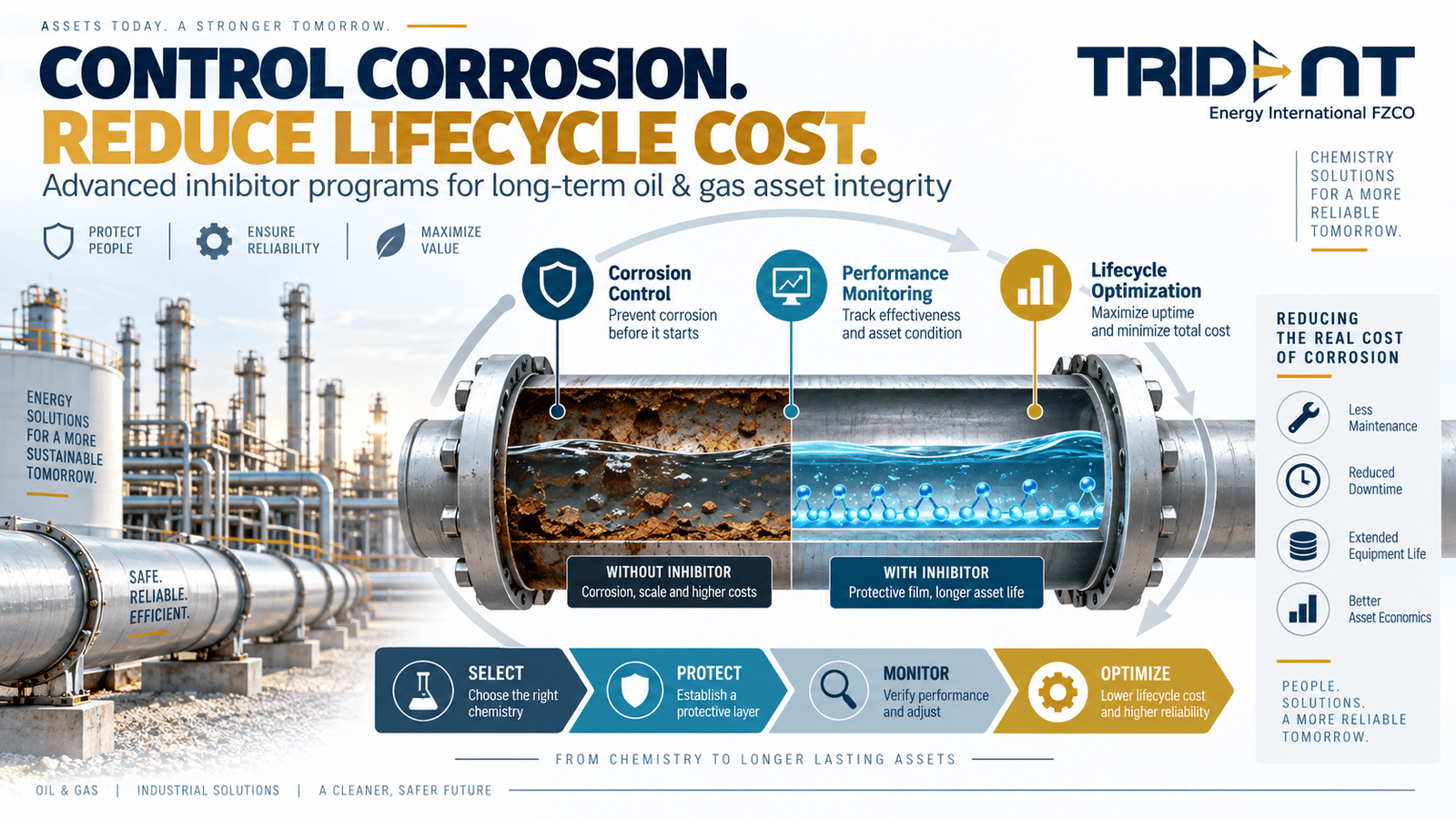
This creates a practical lifecycle loop: characterize the environment, select and qualify the chemistry, apply the treatment, monitor performance, evaluate the results, and adjust when conditions require it.
The value of this approach is not limited to corrosion prevention. It also creates a more defensible basis for maintenance budgets, chemical consumption, inspection planning, and asset-integrity decisions.
Conclusion
Advanced corrosion inhibitor programs should not be judged by chemical consumption alone.
Their real value lies in controlling the interaction between corrosive fluids and metal surfaces while supporting the wider integrity and production objectives of the asset. When inhibitor selection is based on representative conditions, qualification is performed before deployment, treatment delivery is monitored, corrosion response is measured, and the program evolves with changing operating conditions, chemical treatment becomes part of a broader lifecycle strategy.
The economics then become clearer. The objective is not simply to buy less inhibitor. It is to reduce the total cost associated with corrosion while maintaining the level of protection the asset requires.
For oil and gas operators, that means looking beyond the chemical invoice and considering the full chain of consequences—from corrosion rates and inspection findings to maintenance, production availability, equipment life, and failure risk.
A corrosion inhibitor program is most valuable when it prevents a future cost that never appears on the maintenance report.
Lifecycle cost reduction begins with treating corrosion control as an engineering system—one that is measured, managed, and improved throughout the life of the asset.
FAQs
1. What is a corrosion inhibitor program in oil and gas?
A corrosion inhibitor program is a planned approach to controlling corrosion in oil and gas equipment through appropriate chemical treatment, monitoring, performance evaluation, and ongoing adjustment. The objective is to maintain adequate protection under the actual operating conditions of the asset.
2. How can corrosion inhibitors reduce lifecycle costs?
Corrosion inhibitors can help reduce lifecycle costs by controlling corrosion before it develops into leaks, equipment damage, unplanned maintenance, production deferment, or premature replacement. The economic benefit depends on selecting suitable chemistry, applying it at an appropriate treatment level, and monitoring performance.
3. Why is corrosion monitoring important for inhibitor programs?
Monitoring provides evidence of whether the treatment is achieving the required corrosion-control performance. Corrosion-rate measurements, inspection results, fluid analysis, and chemical-delivery data can help engineers identify changes in corrosion behaviour and determine whether treatment needs to be adjusted.
4. Does using more corrosion inhibitor always provide better protection?
No. Increasing inhibitor dosage does not automatically produce proportionally better corrosion protection. Excessive treatment can increase chemical costs without providing meaningful additional benefit, while insufficient treatment may leave the asset inadequately protected. The appropriate treatment level depends on the specific environment and inhibitor chemistry.
5. What factors influence corrosion inhibitor selection?
Selection can depend on factors such as metallurgy, water chemistry, corrosive species, temperature, pressure, flow conditions, produced-fluid characteristics, treatment chemistry, and compatibility with other chemicals used in the system. Representative laboratory testing can help establish whether a formulation is appropriate for the intended application.
6. Why should corrosion inhibitor programs change over an asset's lifecycle?
Production conditions can change as an oil and gas asset matures. Water production, fluid composition, pressure, temperature, flow conditions, and operating practices may all evolve. A treatment that was appropriate during an earlier production phase may therefore require reassessment as the environment changes.
7. What is the difference between corrosion control and corrosion cost optimization?
Corrosion control focuses on maintaining the required level of protection against corrosion. Cost optimization considers that protection together with chemical consumption, monitoring, inspection, maintenance, failure risk, and production consequences. The goal is to achieve reliable protection at an appropriate total lifecycle cost.
8. Can corrosion inhibitors replace materials selection and inspection?
Generally, corrosion inhibitors are one component of a broader corrosion-management strategy. Materials selection, inspection, monitoring, design, operational controls, and chemical treatment can work together to manage corrosion risk. An inhibitor program should not be considered a substitute for appropriate asset-integrity practices.



