
Introduction
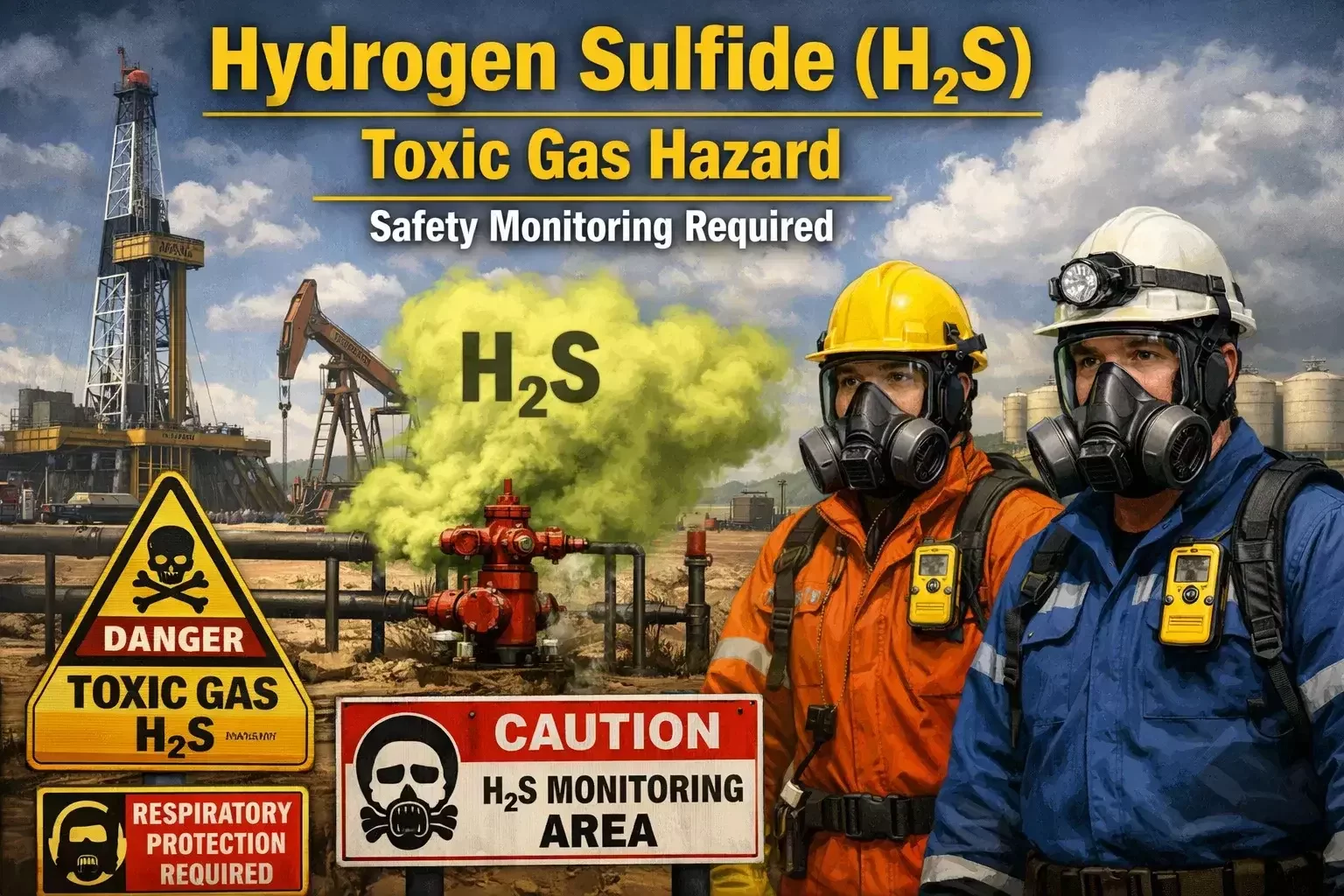
In oil and gas operations, few challenges are as critical—and as dangerous—as the presence of hydrogen sulfide (H₂S). Commonly referred to as “sour gas,” H₂S is a highly toxic, corrosive, and flammable gas that poses serious risks to personnel, infrastructure, and overall production efficiency.
From upstream exploration and drilling to midstream transportation and processing, H₂S can be encountered at multiple stages of hydrocarbon production. Its presence not only threatens operational safety but also accelerates equipment degradation, increases maintenance costs, and complicates regulatory compliance.
To address these challenges, the industry relies on H₂S scavenger solutions—specialized chemical systems designed to neutralize hydrogen sulfide and ensure safe, efficient operations.
As oilfields become more complex and production environments more demanding, effective H₂S management has evolved from a safety requirement into a strategic operational necessity.
What is Hydrogen Sulfide (H₂S)?
Hydrogen sulfide is a colorless gas known for its characteristic “rotten egg” odor at low concentrations. However, at higher concentrations, it becomes particularly dangerous because it can paralyze the sense of smell, making it undetectable without proper monitoring equipment.
Chemically, H₂S is a weak acid gas that forms when sulfur-containing organic materials decompose under anaerobic conditions. It is commonly found in:
• Sour crude oil reservoirs
• Natural gas deposits
• Produced water systems
• Refinery and processing environments
In oil and gas operations, H₂S can exist in dissolved form within fluids or as a free gas phase, making its behavior complex and challenging to control.
Why H₂S is a Critical Concern in Oil & Gas Operations
The risks associated with hydrogen sulfide extend across multiple dimensions, making it one of the most significant hazards in the industry.
1. Extreme Toxicity and Safety Risk
H₂S is highly toxic even at low concentrations. Exposure to high levels can lead to respiratory failure, unconsciousness, and, in severe cases, fatality within minutes.
For this reason, strict safety protocols, detection systems, and mitigation strategies are essential in any operation where H₂S is present.
2. Severe Corrosion of Equipment
Hydrogen sulfide is highly corrosive, particularly in the presence of water. It reacts with metals to form iron sulfide, leading to:
• Pipeline corrosion
• Tubing and casing degradation
• Equipment failure
This type of corrosion, often referred to as sulfide stress cracking (SSC), can significantly reduce the lifespan of critical infrastructure.
3. Production and Flow Assurance Challenges
H₂S can impact production systems by:
• Reacting with other chemicals in the system
• Affecting fluid properties
• Contributing to scaling and deposition
In midstream operations, it also complicates gas processing and transportation due to strict quality specifications for gas sales.
4. Environmental and Regulatory Impact
The release of hydrogen sulfide into the environment is strictly regulated due to its toxicity and environmental hazards.
Operators must ensure compliance with emission standards and safety regulations, making H₂S control a key component of responsible operations.
Sources of H₂S in Upstream and Midstream Operations
Understanding where H₂S originates is essential for designing effective mitigation strategies.
In Upstream Operations
During drilling and production, H₂S may be encountered in:
• Sour reservoirs containing sulfur compounds
• Formation fluids brought to the surface
• Microbial activity, particularly sulfate-reducing bacteria (SRB)
In these environments, H₂S can be present both in dissolved form and as free gas, requiring continuous monitoring and treatment.
In Midstream Operations
As hydrocarbons are transported and processed, H₂S continues to pose challenges in:
• Pipelines and gathering systems
• Separation units and processing facilities
• Storage tanks and transportation networks
Even small concentrations of H₂S can lead to corrosion and safety risks over time, making consistent control essential.
What are H₂S Scavengers?
H₂S scavengers are chemical compounds specifically designed to react with hydrogen sulfide and convert it into non-toxic, stable byproducts.
Unlike mechanical or physical separation methods, scavengers work through chemical reactions, enabling rapid and effective removal of H₂S from both liquid and gas streams.
These solutions are widely used across upstream and midstream operations due to their:
• Fast reaction kinetics
• Flexibility in application
• Compatibility with existing systems
How H₂S Scavengers Work
The effectiveness of scavengers lies in their ability to chemically bind with hydrogen sulfide.
When introduced into a system, scavenger molecules react with H₂S to form stable compounds that can be safely handled or removed.
This process:
• Reduces H₂S concentration in fluids
• Prevents corrosion reactions
• Enhances safety conditions
• Improves product quality
Depending on the application, scavengers may be injected into pipelines, added to storage tanks, or used in treatment systems.
The Strategic Importance of H₂S Management
In modern oil and gas operations, H₂S management is not just about hazard control—it is about ensuring operational continuity and asset reliability.
Without effective scavenging:
• Equipment degradation accelerates
• Maintenance costs increase
• Production efficiency declines
• Safety risks escalate
By integrating H₂S scavenger solutions into production and transportation systems, operators can maintain safer working environments and optimize long-term performance.
Types of H₂S Scavengers Used in Oil & Gas Operations
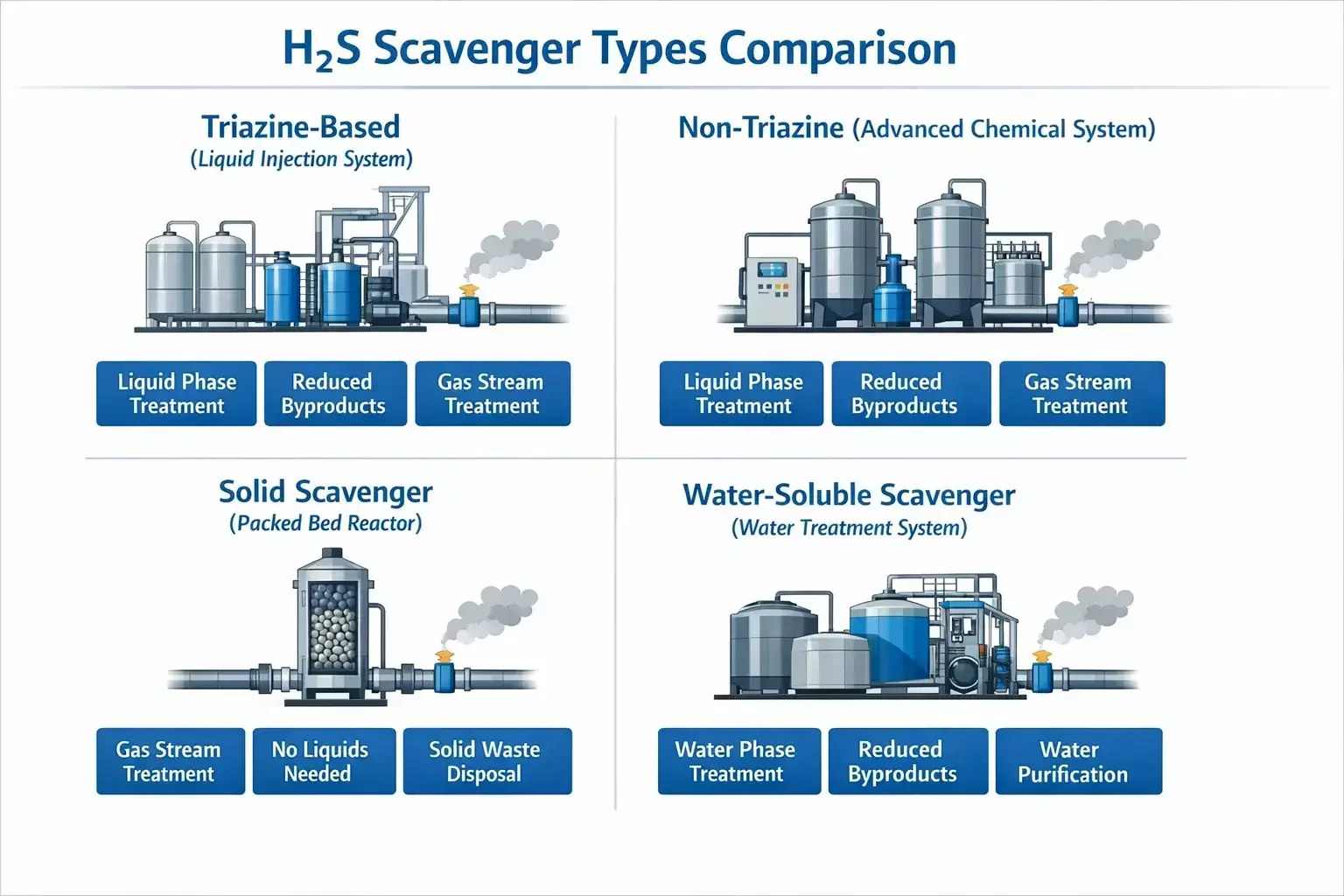
H₂S scavengers are not a single standardized solution. Different chemical systems are designed to address varying operational conditions such as temperature, pressure, phase (gas or liquid), and H₂S concentration levels.
Selecting the right scavenger requires a clear understanding of both chemical behavior and field conditions.
1. Triazine-Based Scavengers
Triazine-based scavengers are among the most widely used H₂S removal chemicals in oil and gas operations.
These scavengers react with hydrogen sulfide to form stable, non-volatile byproducts, effectively removing H₂S from hydrocarbon streams.
Key Characteristics
Triazine scavengers are highly effective in liquid hydrocarbon systems, particularly in crude oil and condensate streams. They are easy to handle and can be injected directly into production systems.
Their fast reaction rate makes them suitable for real-time H₂S control in flowing systems.
Applications
Triazine-based systems are commonly used in:
• Production flowlines
• Storage tanks
• Crude oil treatment systems
Limitations
Despite their effectiveness, triazine scavengers can produce byproducts that may lead to fouling or deposition in equipment if not properly managed.
2. Non-Triazine Liquid Scavengers
Non-triazine scavengers include a range of chemical compounds designed to overcome some of the limitations of traditional triazine systems.
These formulations are often used where byproduct management, compatibility, or performance optimization is a concern.
Key Characteristics
Non-triazine scavengers can offer:
• Reduced solids formation
• Improved compatibility with other chemicals
• Enhanced performance under specific conditions
They are particularly useful in systems where fouling must be minimized.
Applications
These scavengers are used in:
• High-flow production systems
• Sensitive processing environments
• Systems prone to scaling or deposition
3. Solid Scavengers
Solid scavengers are typically used in gas treatment applications, where H₂S is present in gaseous streams.
These materials react with hydrogen sulfide as gas passes through a packed bed or filtration system.
Key Characteristics
Solid scavengers are effective in:
• Continuous gas treatment systems
• Fixed-bed reactors
• Pipeline gas processing
They provide a physical and chemical barrier for H₂S removal.
Applications
Commonly used in:
• Natural gas processing units
• Gas pipelines
• Wellhead gas treatment systems
Limitations
Solid scavengers require periodic replacement or regeneration, making them less flexible compared to liquid systems.
4. Water-Soluble Scavengers
Water-soluble scavengers are designed to treat H₂S present in aqueous phases, such as produced water or water-rich systems.
Key Characteristics
These scavengers dissolve in water and react with dissolved H₂S, making them effective for water handling systems.
Applications
They are commonly applied in:
• Produced water treatment
• Water injection systems
• Separation units
Selecting the Right H₂S Scavenger
Choosing the appropriate scavenger is a critical step that directly impacts operational efficiency, safety, and cost.
Several key factors must be considered when selecting an H₂S scavenger solution.
1. Phase of Operation (Gas vs Liquid)
The form in which H₂S is present determines the type of scavenger required.
Liquid scavengers are more effective in crude oil and water systems, while solid scavengers are typically used in gas streams.
2. H₂S Concentration Levels
Low concentrations of H₂S may be managed with standard scavenger systems, while high concentrations require more robust and high-capacity formulations.
3. Temperature and Pressure Conditions
Downhole and surface conditions influence the reactivity and stability of scavenger chemicals.
High-temperature environments may require specialized formulations that remain effective under extreme conditions.
4. Compatibility with Existing Systems
Scavengers must be compatible with other chemicals in the system, such as corrosion inhibitors, demulsifiers, and scale inhibitors.
Incompatibility can reduce effectiveness or create operational issues.
5. Byproduct Management
The reaction between scavengers and H₂S produces by-products that must be managed carefully.
Selecting a scavenger with minimal or manageable by-products is essential to avoid fouling and operational disruptions.
6. Injection Strategy and Operational Flexibility
The ease of injection and adaptability of the scavenger system are important considerations.
Operators often prefer solutions that can be easily integrated into existing infrastructure without major modifications.
The Role of Chemical Engineering in Scavenger Selection
Modern H₂S scavenger programs are not based on trial and error—they are engineered solutions tailored to specific field conditions.
Laboratory testing, field trials, and continuous monitoring are used to optimize scavenger performance.
This ensures that the selected solution delivers:
• Maximum H₂S removal efficiency
• Minimal operational disruption
• Long-term system stability
Bridging Upstream and Midstream Requirements
H₂S control strategies must be aligned across both upstream and midstream operations.
In upstream environments, the focus is often on real-time scavenging during production, while in midstream systems, the emphasis shifts toward pipeline integrity and gas quality compliance.
An integrated approach ensures that H₂S is managed consistently throughout the production chain.
Application of H₂S Scavengers in Field Operations
The effectiveness of H₂S scavenger solutions depends not only on chemical selection but also on how and where they are applied within the production system.
In both upstream and midstream operations, scavengers must be strategically introduced into the system to ensure maximum contact with hydrogen sulfide. Improper application can result in incomplete treatment, inefficient chemical usage, and persistent H₂S-related risks.
A well-designed application strategy ensures that scavengers react efficiently with H₂S before it can cause corrosion, safety hazards, or processing issues.
Injection Points in Upstream Operations
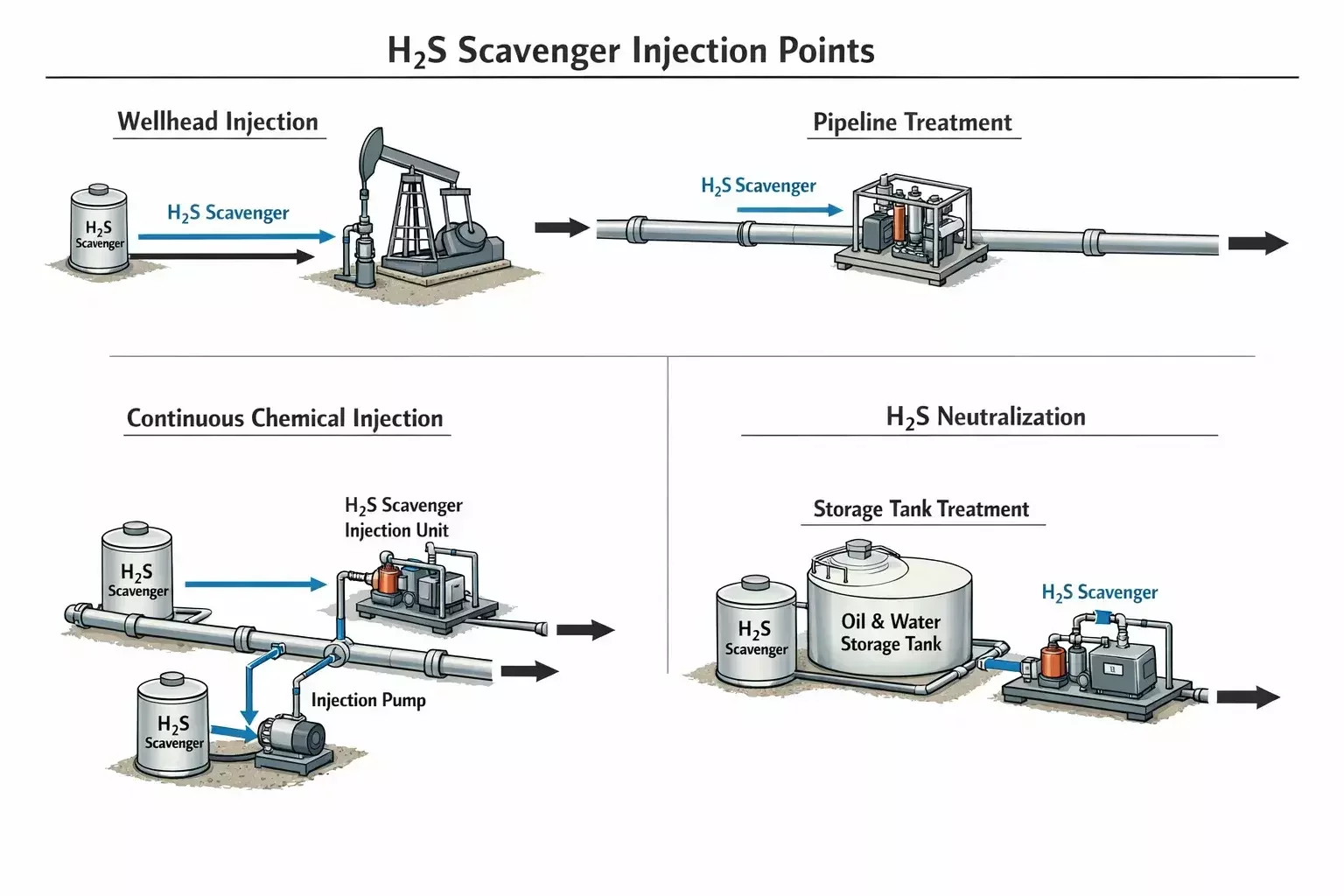
In upstream environments, H₂S scavengers are typically injected at multiple points to ensure continuous control throughout the production process.
Wellhead Injection
One of the most common injection points is at the wellhead. Introducing scavengers at this stage allows early neutralization of H₂S as hydrocarbons begin flowing to the surface.
This helps protect downstream equipment and reduces the risk of corrosion in flowlines and gathering systems.
Downhole Injection
In certain cases, scavengers are injected directly into the wellbore. This approach is particularly useful in reservoirs with high H₂S concentrations.
Downhole injection enables early-stage treatment, preventing H₂S from interacting with tubing and other production equipment.
However, this method requires careful design to ensure compatibility with downhole conditions such as temperature and pressure.
Flowline and Gathering System Injection
As production fluids move through flowlines, additional scavenger injection points may be used to maintain effective H₂S control.
This is especially important in long-distance transportation systems where H₂S levels can fluctuate due to changing conditions.
Application in Midstream Operations
In midstream systems, H₂S scavenging focuses on maintaining pipeline integrity and product quality.
Pipeline Injection Systems
Scavengers are injected into pipelines to continuously treat flowing hydrocarbons. Proper injection ensures uniform distribution and effective reaction with H₂S throughout the pipeline.
This helps prevent corrosion and ensures compliance with gas and crude quality specifications.
Storage Tank Treatment
In storage tanks, H₂S can accumulate in both liquid and vapor phases. Scavengers are added to reduce H₂S concentration and minimize vapor-phase hazards.
This improves safety conditions and reduces emissions.
Gas Processing Units
In gas processing facilities, scavengers may be used as part of treatment systems to remove H₂S before gas is transported or sold.
This ensures that gas meets regulatory and commercial quality standards.
Injection Techniques and System Design
The success of an H₂S scavenger program depends heavily on the design of the injection system.
Continuous Injection
Continuous injection is the most commonly used method, where scavengers are introduced at a steady rate into the system.
This approach ensures consistent H₂S control and is suitable for operations with stable production conditions.
Batch Treatment
In batch treatment, a specific volume of scavenger is injected periodically.
This method is often used in storage tanks or systems where H₂S levels fluctuate.
While cost-effective in certain scenarios, batch treatment requires careful monitoring to ensure effectiveness.
Slug Injection
Slug injection involves injecting a concentrated volume of scavenger over a short period.
This technique is typically used to address sudden spikes in H₂S concentration or to clean specific sections of the system.
Key Factors Influencing Application Efficiency
Several factors determine how effectively H₂S scavengers perform in field conditions.
Contact Time
For a scavenger to react completely with H₂S, sufficient contact time is required. Injection points and flow rates must be designed to maximize interaction between the chemical and the gas.
Mixing Efficiency
Proper mixing ensures that scavengers are evenly distributed within the fluid stream.
Poor mixing can lead to localized treatment and incomplete H₂S removal.
Temperature and Pressure
Reaction rates are influenced by temperature and pressure conditions. High temperatures may accelerate reactions, while extreme conditions may require specialized formulations.
Fluid Composition
The presence of other chemicals, water content, and hydrocarbons can impact scavenger performance.
Compatibility with existing chemical systems is essential for maintaining efficiency.
Operational Best Practices for H₂S Scavenger Programs
To achieve consistent and reliable performance, operators must adopt best practices in scavenger application.
Monitoring and Measurement
Regular monitoring of H₂S levels is critical to ensure that scavenger programs are effective.
Advanced detection systems allow operators to track changes in concentration and adjust treatment strategies accordingly.
Optimization of Chemical Dosage
Overdosing increases operational costs, while underdosing leads to ineffective treatment.
Optimizing dosage based on real-time data ensures cost efficiency and performance.
Integration with Other Chemical Programs
H₂S scavengers must work in harmony with other chemicals such as corrosion inhibitors, demulsifiers, and scale inhibitors.
An integrated chemical management approach improves overall system performance.
Preventive Maintenance
Regular inspection of injection systems, pipelines, and processing units helps identify potential issues early and ensures uninterrupted operation.
The Importance of System-Level Thinking
Effective H₂S control is not limited to a single injection point or treatment method. It requires a system-wide approach that considers the entire production and transportation network.
From wellhead to processing facility, scavenger solutions must be designed to deliver consistent performance across all stages of operation.
Key Benefits of H₂S Scavenger Solutions
The implementation of effective H₂S scavenger programs delivers significant operational, safety, and economic benefits across upstream and midstream operations.
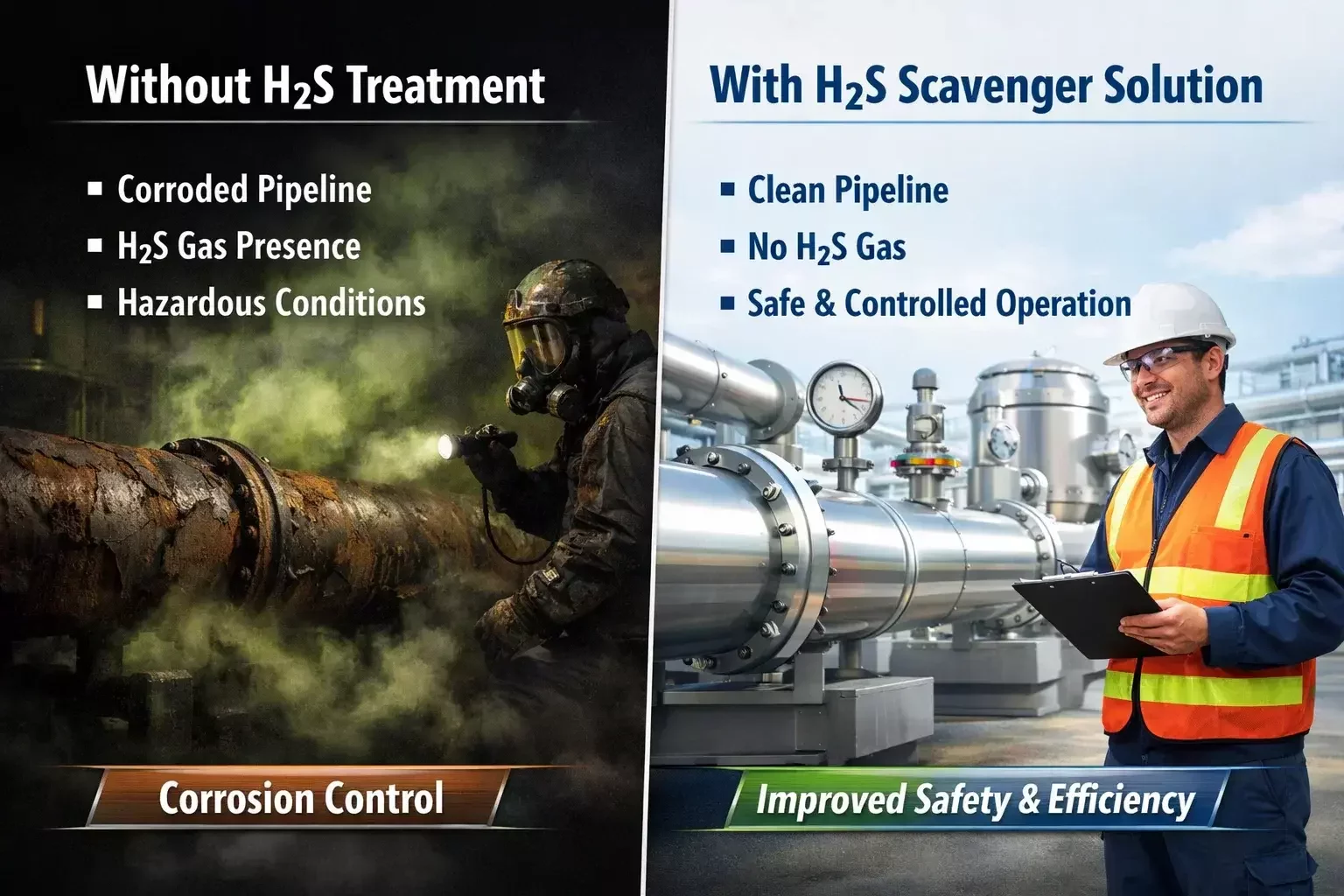
One of the most critical advantages is enhanced safety. By reducing or eliminating hydrogen sulfide from production streams, scavengers help create a safer working environment for personnel, minimizing exposure risks and ensuring compliance with safety standards.
Another major benefit is corrosion control. Since H₂S is a primary contributor to sulfide stress cracking and metal degradation, its removal significantly extends the lifespan of pipelines, tubing, and processing equipment. This directly reduces maintenance requirements and capital expenditure.
From a production standpoint, scavenger solutions improve operational efficiency. By preventing chemical reactions that interfere with fluid properties and equipment performance, they help maintain stable production rates and reduce downtime.
In midstream operations, H₂S scavengers play a key role in ensuring that hydrocarbons meet quality specifications for transportation and sale. This is particularly important for natural gas, where strict limits on H₂S content must be maintained.
Challenges and Limitations
Despite their effectiveness, H₂S scavenger solutions come with certain challenges that must be carefully managed.
One of the primary concerns is byproduct formation. The chemical reaction between scavengers and H₂S produces compounds that may accumulate in the system, potentially leading to fouling or blockages if not properly controlled.
Another challenge is chemical consumption and cost optimization. Continuous injection programs require a steady supply of chemicals, and inefficient dosing can lead to increased operational costs.
Additionally, variations in field conditions—such as fluctuating H₂S concentrations, temperature changes, and fluid composition—can impact scavenger performance. This necessitates continuous monitoring and adjustment of treatment strategies.
Compatibility with other chemical systems is also a key consideration. Improper integration can reduce overall effectiveness and lead to unintended operational issues.
Environmental and Regulatory Considerations
Environmental responsibility is a growing priority in oil and gas operations, and H₂S management is closely tied to regulatory compliance.
Hydrogen sulfide emissions are strictly regulated due to their toxic nature and environmental impact. Effective scavenger programs help operators meet emission standards and avoid regulatory penalties.
However, the use of chemical scavengers must also be managed carefully. Operators need to ensure that:
• Scavenger formulations are environmentally acceptable
• Byproducts are properly handled and disposed of
• Chemical usage is optimized to minimize environmental footprint
In offshore and sensitive environments, these requirements become even more stringent, driving the demand for eco-friendly scavenger solutions.
Integrating H₂S Scavenging into a Broader Chemical Strategy
H₂S scavenger programs should not be viewed in isolation. Instead, they must be integrated into a broader chemical management strategy that includes:
• Corrosion inhibitors for asset protection
• Scale inhibitors for deposit control
• Demulsifiers for efficient separation
This integrated approach ensures that all aspects of production and processing are aligned, resulting in improved system performance and reliability.
The Future of H₂S Control in Oil & Gas
As oilfields become more complex and production conditions more challenging, the demand for advanced H₂S control solutions continues to grow.
Emerging trends include:
• Development of high-efficiency, low-toxicity scavengers
• Improved formulations with reduced byproduct formation
• Real-time monitoring systems for dynamic chemical dosing
• Integration of digital tools for predictive chemical management
These innovations are enabling operators to manage H₂S more effectively while reducing costs and environmental impact.
Conclusion
Hydrogen sulfide remains one of the most critical challenges in upstream and midstream oil and gas operations, affecting safety, equipment integrity, and production efficiency.
H₂S scavenger solutions provide a reliable and flexible method for controlling this hazardous gas, enabling operators to maintain safe working conditions and protect valuable assets.
From wellhead injection to pipeline treatment and storage systems, scavengers play a vital role across the entire production chain. However, their effectiveness depends on proper selection, application, and integration with broader chemical programs.
As the industry continues to evolve, the importance of strategic, well-designed H₂S management solutions will only increase.
Ultimately, successful H₂S control is not just about removing a harmful gas—it is about ensuring safe, efficient, and sustainable oil and gas operations.
FAQs
1. What is an H₂S scavenger in oil and gas?
An H₂S scavenger is a chemical solution used to remove hydrogen sulfide from oil, gas, or water streams by converting it into non-toxic and stable compounds.
2. Why is hydrogen sulfide dangerous in oilfield operations?
Hydrogen sulfide is highly toxic, corrosive, and flammable. It poses serious risks to human safety, equipment integrity, and environmental compliance.
3. Where are H₂S scavengers used in oil and gas operations?
They are used in upstream and midstream operations, including wellheads, pipelines, storage tanks, and gas processing facilities.
4. What are the main types of H₂S scavengers?
Common types include triazine-based scavengers, non-triazine liquid scavengers, solid scavengers, and water-soluble scavengers.
5. How do H₂S scavengers work?
They react chemically with hydrogen sulfide to form stable byproducts, effectively reducing H₂S concentration in the system.
6. What is the difference between triazine and non-triazine scavengers?
Triazine scavengers are widely used and effective but may produce byproducts, while non-triazine scavengers are designed to reduce fouling and improve system compatibility.
7. Can H₂S scavengers be used in gas pipelines?
Yes, solid and liquid scavengers are commonly used in gas pipelines to maintain gas quality and prevent corrosion.
8. How are H₂S scavengers injected into systems?
They can be applied through continuous injection, batch treatment, or slug dosing, depending on operational requirements.
9. What challenges are associated with H₂S scavenger programs?
Challenges include byproduct formation, dosing optimization, compatibility with other chemicals, and changing field conditions.
10. Are H₂S scavengers environmentally safe?
Modern formulations are designed to be more environmentally acceptable, but proper handling, dosage control, and disposal are essential for compliance.



