
Introduction
Oilfield chemistry has evolved far beyond the use of highly aggressive mineral acids alone. As reservoirs become more challenging, production infrastructure ages, and operators seek safer, more controlled stimulation techniques, the industry increasingly relies on specialty chemicals that solve multiple operational problems simultaneously.
Among these chemicals, citric acid occupies a unique position. Often recognized in food and pharmaceutical industries as a naturally occurring organic acid, citric acid performs an entirely different role within oilfield operations. Rather than acting as a simple acidifier, it functions as a versatile chemical capable of controlling iron, stabilizing dissolved metals, conditioning treatment fluids, and supporting acid stimulation programs where controlled reactions are preferred over aggressive chemical attack.
Its comparatively mild acidity allows engineers to manage complex chemical environments while reducing many of the operational challenges associated with stronger inorganic acids. This combination of moderate reactivity, excellent metal-binding capability, and broad chemical compatibility has made citric acid an important component in drilling, stimulation, completion, and production chemical programs across the oil and gas industry.
As modern wells continue moving into higher temperatures, more complex formations, and increasingly demanding operating environments, understanding how mild organic acids contribute to production efficiency has become more important than ever.
The Evolution of Acid Chemistry in Oilfield Operations
For decades, hydrochloric acid and hydrofluoric acid have remained the primary chemicals used during well stimulation because of their ability to dissolve carbonate minerals and improve reservoir permeability. While these acids remain highly effective for many applications, their aggressive reaction rates can create operational challenges.
Rapid acid-rock reactions may limit treatment penetration, increase corrosion risk, accelerate iron precipitation, and require extensive corrosion inhibition programs. In formations containing complex mineralogy or aging infrastructure, engineers often seek alternatives that provide greater control over chemical behavior.
This need has encouraged wider adoption of organic acids and chelating agents. Rather than replacing conventional acid systems entirely, these chemicals complement them by improving treatment stability, managing dissolved metals, and extending chemical effectiveness throughout the stimulation process.
Citric acid represents one of the most widely used examples of this approach because it contributes both mild acidity and effective metal sequestration within a single chemical.
What Makes Citric Acid Different?
Unlike strong mineral acids that dissociate almost completely upon contact with water, citric acid is a weak organic acid with a more gradual reaction profile. This characteristic allows engineers to introduce acidity into a system without creating excessively rapid reactions.
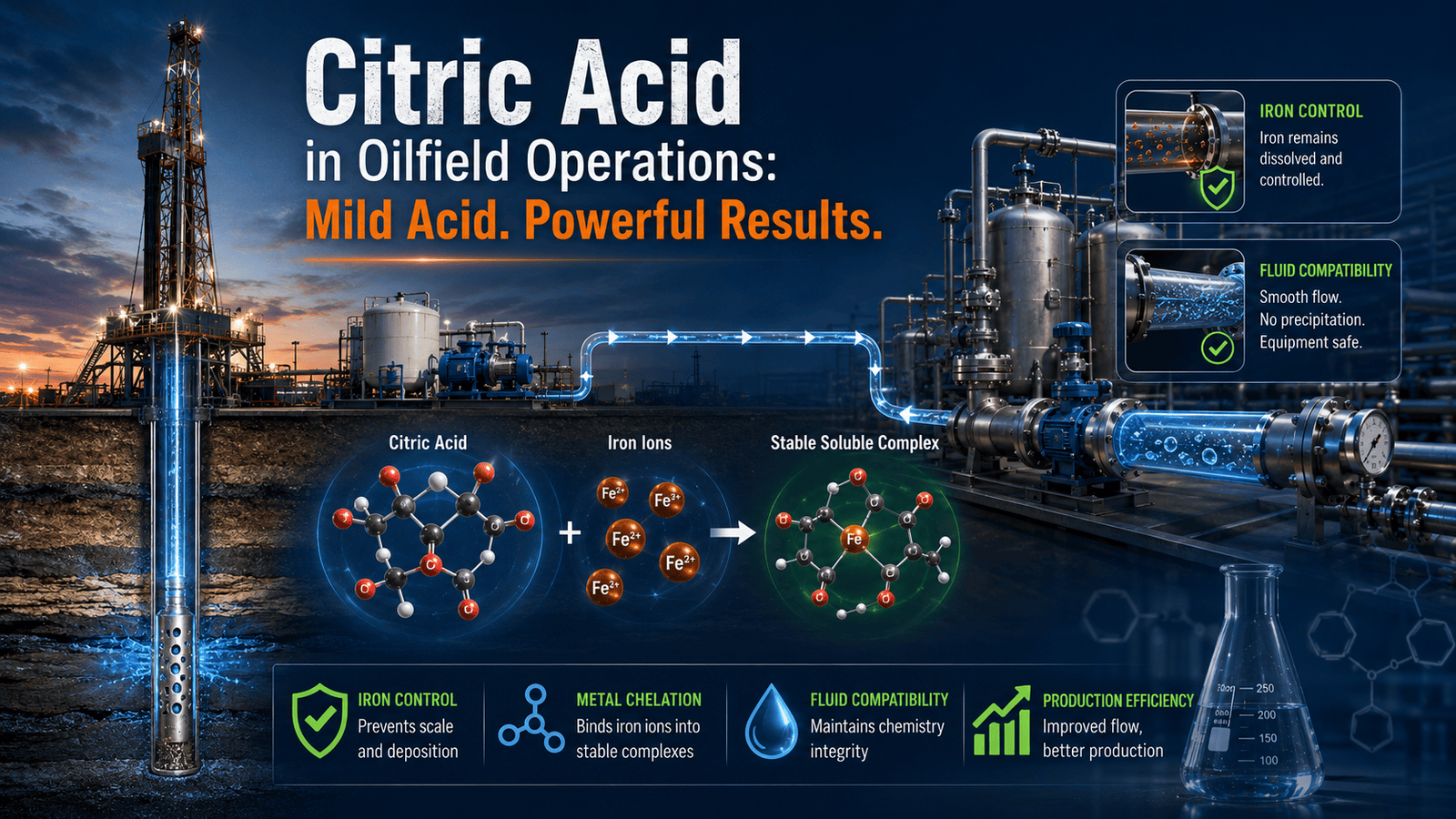
However, acidity alone is not what makes citric acid valuable. Its molecular structure contains multiple carboxyl functional groups capable of binding dissolved metal ions through a process known as chelation. Instead of allowing metals such as iron or calcium to precipitate as insoluble solids, citric acid forms stable soluble complexes that remain suspended within the treatment fluid.
This dual functionality—providing controlled acidity while simultaneously stabilizing dissolved metals—distinguishes citric acid from many conventional acid systems. In oilfield applications, citric acid is commonly used as an iron-control agent and chelating additive because it helps keep dissolved iron in solution during acidizing and cleanup operations, reducing the risk of damaging precipitates.
Why Iron Control Is So Important
One of the less visible challenges during acid stimulation is iron contamination. Iron may originate from corrosion products, mill scale, tubulars, formation minerals, or production equipment exposed to acidic environments.
As treatment fluids react and their chemistry changes, dissolved iron can convert into insoluble compounds such as ferric hydroxide or iron sulfide. These precipitates create new formation damage while the original treatment is still underway. Instead of improving permeability, operators may unintentionally reduce it. Citric acid helps reduce this risk by binding iron ions before precipitation occurs.
The resulting soluble complexes remain suspended within the treatment fluid and can be recovered during flowback rather than depositing inside pore spaces. Because iron precipitation is one of the leading causes of secondary formation damage during acid treatments, effective iron control significantly improves overall stimulation efficiency.
Mild Chemistry with Multiple Functions
Modern production chemicals are expected to perform several tasks simultaneously. Citric acid is particularly valuable because it contributes to multiple operational objectives without requiring numerous separate additives.
Depending on the application, it may assist with pH adjustment, iron stabilization, calcium control, cement contamination management, and compatibility improvement within drilling and stimulation fluids. Industry guidance also highlights its ability to reduce pH, sequester iron, and help manage soluble calcium while minimizing unwanted polymer interactions.
Rather than functioning as a single-purpose chemical, citric acid becomes part of an integrated chemical program where each additive supports the performance of the others. This systems-based approach has become increasingly important as modern wells require more sophisticated fluid designs.
Supporting Safer and More Controlled Treatments
Another advantage of citric acid lies in its comparatively controlled reaction behavior. Because it reacts less aggressively than strong mineral acids, engineers often have greater flexibility when designing treatments for sensitive formations or equipment.
Slower reaction kinetics can improve chemical placement while reducing localized heat generation and minimizing the likelihood of excessively rapid mineral dissolution. Although treatment design always depends on reservoir characteristics, this controlled behavior makes citric acid an attractive option for applications where precision is more valuable than reaction speed.
Instead of maximizing immediate dissolution, operators focus on maximizing treatment effectiveness across the entire intervention.
Citric Acid Across the Oilfield Lifecycle
The versatility of citric acid becomes evident when examining its role across different stages of oil and gas operations. Unlike specialty chemicals designed for a single purpose, citric acid is incorporated into a variety of fluid systems because it addresses several operational challenges simultaneously.
From drilling and well construction to stimulation, production, and maintenance, the chemical contributes to improved fluid performance, better equipment protection, and greater process stability.
Its effectiveness stems from its ability to influence the chemistry of the entire treatment system rather than simply reacting with one specific component. By controlling dissolved metals, maintaining fluid compatibility, and moderating chemical reactions, citric acid supports smoother operations throughout the well lifecycle.
Iron Control During Acid Stimulation
One of the most significant applications of citric acid is in acid stimulation treatments where iron contamination can compromise the success of the operation.
When mineral acids such as hydrochloric acid react with steel tubulars or iron-bearing formations, dissolved iron enters the treatment fluid. As the acid becomes spent and the pH begins to increase, this dissolved iron can rapidly precipitate into insoluble compounds.
These precipitates may plug pore spaces, restrict permeability, and reduce the effectiveness of the stimulation treatment that was intended to improve reservoir productivity.
Citric acid helps minimize this risk by acting as a chelating agent. Instead of allowing iron ions to form damaging solids, it binds with them to create stable, water-soluble complexes. This keeps the iron dispersed within the treatment fluid until it can be recovered during flowback.
The result is a cleaner stimulation process with a lower likelihood of secondary formation damage. In complex reservoirs where iron contamination is anticipated, proper iron control often becomes just as important as the acid treatment itself.
Improving Compatibility in Drilling Fluids
Drilling fluids are carefully engineered systems in which every additive must remain chemically compatible with the others. Unexpected interactions between dissolved minerals, polymers, weighting agents, or contaminants can alter fluid properties and reduce drilling efficiency.
Citric acid is frequently introduced into drilling fluid formulations to help regulate pH and manage dissolved metal ions that could otherwise interfere with the performance of the fluid. By reducing the availability of reactive metal ions, citric acid helps maintain the stability of polymer-based additives and supports more predictable rheological behavior. This contributes to improved fluid consistency, more reliable solids suspension, and better overall drilling performance.
Rather than acting as a primary drilling additive, citric acid serves as a supporting chemical that helps preserve the integrity of the complete fluid system.
Supporting Scale and Deposit Management
Mineral scale remains one of the most persistent challenges in oil and gas production. Calcium, magnesium, and iron compounds can gradually accumulate on production tubing, flowlines, separators, heat exchangers, and processing equipment. As deposits increase, fluid flow becomes restricted, heat transfer efficiency declines, and maintenance requirements rise.
Although dedicated scale inhibitors are the primary solution for long-term prevention, citric acid can support cleaning and maintenance operations by interacting with certain metal deposits and helping keep dissolved minerals in solution. Its chelating capability enables it to assist in removing residual metal contamination while reducing the likelihood of redeposition during cleaning procedures. For operators, this translates into improved equipment cleanliness and more efficient maintenance programs.
Enhancing Fluid Compatibility During Well Treatments
Modern well stimulation fluids often contain numerous chemical additives, each serving a specific purpose. Corrosion inhibitors protect tubulars, surfactants improve fluid penetration, friction reducers enhance pumping efficiency, and iron-control agents prevent precipitation.
The success of the treatment depends not only on the performance of each chemical individually but also on how well they function together.
Citric acid contributes by improving the chemical compatibility of these treatment systems. Its ability to stabilize dissolved metals reduces unwanted reactions between additives and helps maintain consistent fluid properties throughout the operation. This becomes particularly valuable during extended stimulation treatments where fluid chemistry changes continuously as reactions progress.
A more chemically stable treatment fluid often results in better placement, improved reservoir contact, and more predictable treatment outcomes.
Equipment Cleaning and Surface Maintenance
Oilfield operations rely heavily on pumps, storage tanks, mixing systems, pipelines, and processing equipment that remain in continuous service under demanding conditions. Over time, these systems accumulate corrosion products, mineral deposits, and process residues that reduce operational efficiency.
Citric acid is commonly selected for cleaning applications because it offers an effective balance between cleaning performance and material compatibility. Its mild acidic nature allows it to dissolve or loosen certain deposits while presenting a lower corrosion risk than many stronger mineral acids when used under appropriate conditions. This makes it suitable for maintenance programs where preserving equipment integrity is just as important as removing unwanted deposits.
Routine cleaning supported by appropriate chemical selection helps reduce downtime, maintain flow efficiency, and extend the service life of critical assets.
Supporting Environmentally Conscious Chemical Programs
As the energy industry continues to place greater emphasis on operational sustainability, chemical selection increasingly considers not only technical performance but also handling characteristics and environmental impact.
Citric acid is biodegradable and generally regarded as having a more favorable environmental profile than many traditional inorganic acids when applied appropriately within industrial systems.
Although every oilfield chemical program must comply with project-specific regulations and environmental requirements, the availability of biodegradable organic acids provides engineers with additional flexibility when designing treatment programs. This has contributed to the continued adoption of citric acid in applications where operational efficiency, safety considerations, and environmental responsibility must all be balanced.
Transition to Advanced Oilfield Applications
The broad range of applications demonstrates that citric acid is far more than a simple organic acid. Its value lies in its ability to solve multiple operational challenges simultaneously—controlling dissolved metals, improving fluid compatibility, supporting equipment maintenance, and enhancing treatment reliability.
In the final section, we will explore the technical advantages of citric acid over stronger acid systems, discuss its operational limitations, and examine why it remains an indispensable component of modern oilfield chemical programs despite its relatively mild chemistry.
Why Engineers Continue to Choose Citric Acid
The effectiveness of an oilfield chemical is rarely determined by how aggressive it is. Instead, engineers evaluate whether it delivers consistent performance, integrates well with other treatment chemicals, minimizes operational risks, and supports long-term production objectives.
Citric acid continues to meet these expectations because it offers a combination of mild acidity and excellent chelating capability. While it cannot replace strong mineral acids for applications requiring rapid dissolution of carbonate formations, it serves an equally important role by improving the overall chemistry of treatment fluids.
In many stimulation programs, the success of the operation depends not only on dissolving formation minerals but also on preventing secondary damage caused by iron precipitation, incompatible fluid interactions, or unstable chemical conditions. Citric acid addresses these supporting challenges, helping treatment systems perform as intended from the beginning of the operation through post-treatment flowback.
This ability to enhance the performance of an entire chemical system rather than acting alone is one of the primary reasons it remains widely used across the oil and gas industry.
Balancing Performance with Operational Safety
Safety is a major consideration in every oilfield operation. Handling highly corrosive chemicals requires strict procedures, specialized equipment, and carefully designed treatment programs to protect personnel and production assets. Although citric acid still requires proper industrial handling, its comparatively mild chemical nature generally makes it easier to integrate into operations where controlled reactions are preferred over highly aggressive acid attack.
A slower and more predictable reaction profile provides engineers with greater flexibility when designing treatments for sensitive formations, aging infrastructure, or operations where maintaining equipment integrity is particularly important.
This controlled behavior also contributes to more stable fluid chemistry, allowing other treatment additives—such as corrosion inhibitors, surfactants, and iron-control agents—to perform more effectively throughout the treatment cycle.
Rather than relying solely on chemical strength, modern stimulation strategies increasingly focus on achieving the desired result through carefully engineered chemical interactions.
Supporting More Efficient Production Operations
Production efficiency is influenced by far more than reservoir characteristics. Fluid compatibility, equipment cleanliness, scale management, corrosion control, and chemical stability all contribute to the long-term productivity of a well.
Citric acid supports these objectives by helping maintain cleaner fluid systems and reducing the likelihood of operational issues associated with dissolved metal precipitation. When treatment fluids remain chemically stable, downstream equipment experiences fewer interruptions caused by deposits, plugging, or inconsistent fluid behavior. This contributes to smoother production, reduced maintenance frequency, and more predictable operational performance. As operators continue extending the productive life of mature oilfields, chemicals that improve system reliability without introducing unnecessary complexity become increasingly valuable.
Citric acid fits well within this philosophy because it complements existing chemical programs while providing multiple functional benefits through a single additive.
Understanding Its Limitations
Despite its versatility, citric acid is not a universal solution for every oilfield challenge. Its relatively weak acidity means it cannot match the rapid mineral dissolution capabilities of hydrochloric acid or hydrofluoric acid during conventional matrix acidizing operations. Where aggressive carbonate dissolution or sandstone stimulation is required, stronger acid systems remain the preferred choice.
Similarly, the effectiveness of citric acid depends on several operational factors, including temperature, fluid composition, pH, contact time, and the concentration of dissolved metal ions.
Selecting the correct dosage requires laboratory testing, compatibility evaluations, and a thorough understanding of reservoir conditions. Overusing any chemical can increase treatment costs without improving performance, while insufficient concentrations may fail to provide the desired level of iron control or metal sequestration. For this reason, successful application of citric acid relies on sound engineering practices rather than standardized formulations.
The Growing Importance of Specialty Chemicals
The oil and gas industry is steadily moving toward more sophisticated chemical programs that prioritize efficiency, precision, and operational sustainability. Modern wells often involve longer horizontal sections, higher bottom-hole temperatures, more complex completion designs, and increasingly demanding production environments. These conditions require chemical systems that can perform multiple functions while remaining compatible with a wide range of additives.
Specialty chemicals such as citric acid are becoming more valuable because they help simplify treatment programs without compromising performance. Instead of adding separate chemicals to address every operational challenge, engineers increasingly seek multifunctional additives capable of improving overall fluid performance.
Advances in laboratory testing, reservoir simulation, and chemical modeling are also enabling operators to optimize the use of organic acids and chelating agents with greater accuracy than ever before. As treatment designs become more data-driven, chemicals like citric acid will continue to play an important supporting role in integrated oilfield chemistry.
Conclusion
Citric acid may be classified as a mild organic acid, but its contribution to oilfield operations is anything but minor. Its ability to control dissolved iron, stabilize treatment fluids, improve chemical compatibility, support equipment maintenance, and assist in production optimization has made it an indispensable component of modern oilfield chemical programs.
Rather than relying on aggressive chemical reactions alone, today's oilfield engineers recognize the importance of controlled chemistry that protects reservoirs, preserves equipment, and enhances treatment efficiency. Citric acid exemplifies this approach by combining moderate acidity with powerful chelating properties, allowing it to solve multiple operational challenges within a single formulation.
As the industry continues to pursue safer operations, higher production efficiency, and more sustainable chemical solutions, the role of multifunctional additives will only become more significant. Citric acid demonstrates that effective oilfield chemistry is not defined by strength alone—it is defined by precision, compatibility, and the ability to deliver consistent results under demanding field conditions.
For operators seeking reliable and well-balanced chemical performance, this mild organic acid continues to prove that sometimes the most effective solutions are those designed to work intelligently rather than aggressively.
Frequently Asked Questions (FAQs)
1. What is citric acid used for in oilfield operations?
Citric acid is primarily used for iron control, metal chelation, pH adjustment, fluid conditioning, equipment cleaning, and improving compatibility in drilling and stimulation fluids.
2. Why is citric acid preferred for iron control?
Its strong chelating properties bind dissolved iron ions, helping prevent iron precipitation that can damage reservoir formations and reduce stimulation effectiveness.
3. Can citric acid replace hydrochloric acid in acidizing?
No. Citric acid is a mild organic acid and is generally used as a supporting additive rather than a replacement for strong mineral acids in conventional acidizing treatments.
4. What is chelation, and why is it important?
Chelation is the process of binding metal ions into stable, soluble complexes. In oilfield operations, this helps keep dissolved metals in solution and reduces the risk of damaging precipitate formation.
5. Is citric acid compatible with other oilfield chemicals?
Yes. Citric acid is commonly incorporated into treatment systems because it improves compatibility with many additives, including corrosion inhibitors, surfactants, and polymers.
6. How does citric acid support drilling fluid performance?
It helps regulate pH, controls dissolved metal ions, and contributes to maintaining the stability of polymer-based drilling fluid systems.
7. Does citric acid help with scale removal?
Citric acid can assist in cleaning certain mineral deposits and metal contamination during maintenance operations, although dedicated scale inhibitors remain the primary solution for scale prevention.
8. Is citric acid environmentally friendly?
Citric acid is biodegradable and generally has a more favorable environmental profile than many strong inorganic acids, though its use must always comply with applicable regulations and project requirements.
9. What industries besides oil and gas use citric acid?
Citric acid is widely used in food processing, pharmaceuticals, water treatment, cleaning products, cosmetics, and industrial manufacturing due to its chelating and pH-control properties.
10. Why is citric acid considered a multifunctional oilfield chemical?
Because it combines mild acidity, iron sequestration, metal chelation, pH adjustment, and fluid compatibility enhancement, allowing it to support multiple aspects of oilfield operations within a single chemical program.



